


Exercise is the single most important factor in a doodle puppy’s physical development, joint health, and long-term behavior. Understanding why exercise matters for doodle puppies means knowing that the wrong amount, in either direction, causes real and lasting harm. The good news is that a simple, consistent routine protects your puppy’s growing body and shapes a calmer, more confident adult dog. Lakewoodranchdoodles has spent over 20 years watching the difference between puppies raised with structured activity and those left to run without limits. The gap in outcomes is significant.
Why exercise matters for doodle puppies at every growth stage
The 5-minute rule is the starting point for every doodle puppy owner. Structured walks should be limited to no more than 5 minutes per month of age, twice daily. A 3-month-old puppy gets 15 minutes per session. A 5-month-old gets 25 minutes. That limit exists because doodle puppies are still growing, and their growth plates are the most vulnerable part of their skeleton.
Growth plates are cartilaginous zones at the ends of long bones. They lack pain receptors, which means damage accumulates silently. Your puppy will not limp or cry when a growth plate is stressed. The injury shows up months later as dysplasia, arthritis, or a visible bone deformity. By then, the damage is done.
The timeline for growth plate closure varies by size. Mini doodles close at 10–12 months. Medium doodles close at 12–15 months. Standard doodles close at 15–18 months. You can review size and structure differences to understand how your puppy’s adult size affects this timeline. Once plates close, adult exercise needs shift to 30–60 minutes of structured daily activity depending on size and energy level.
| Age | Max walk duration | Safe activity types |
|---|---|---|
| 2–3 months | 10–15 min per session | Gentle yard play, short leash walks |
| 4–5 months | 20–25 min per session | Leash walks, calm sniff games |
| 6–9 months | 30–45 min per session | Longer walks, light training |
| 10–12 months | 50–60 min per session | Brisk walks, swimming, structured play |
| 12+ months (adult) | 30–90 min daily | Full activity per size and breed |
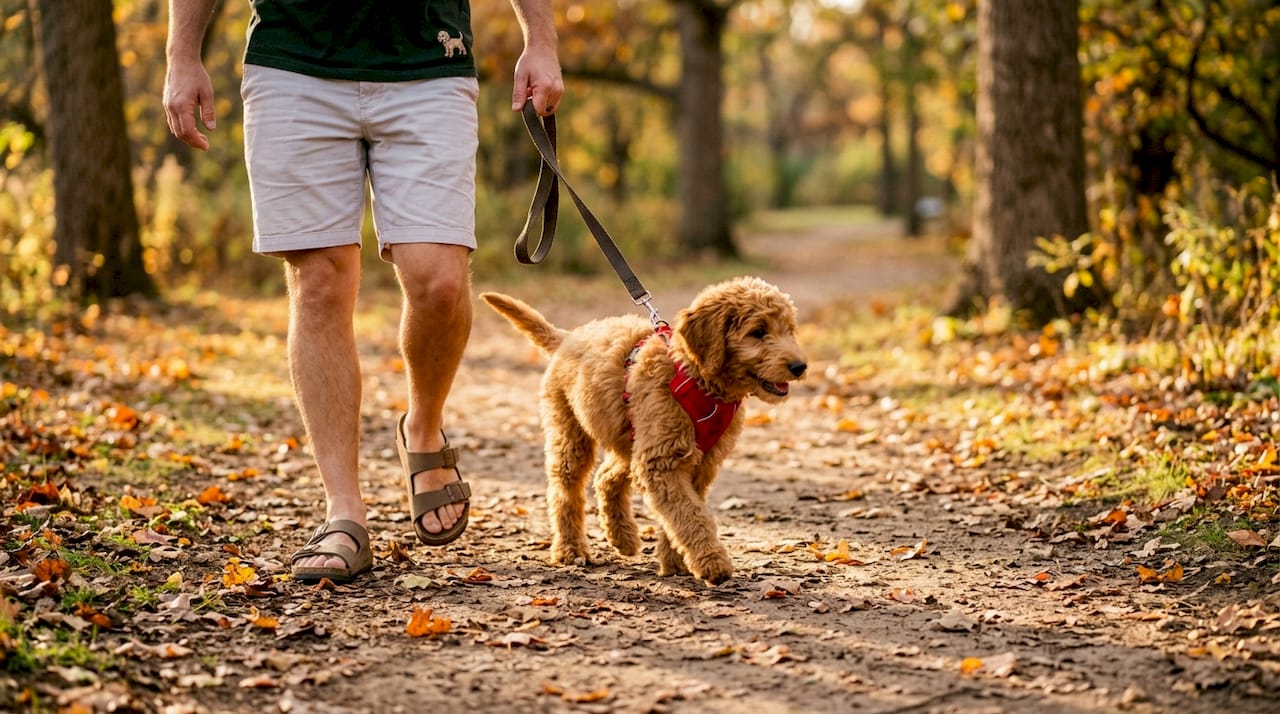
Pro Tip: Fetch involves repeated sprinting and hard landings. It stresses growth plates even when it looks like harmless play. Hold off on fetch until your puppy’s growth plates have fully closed.
What are the risks of over-exercising and under-exercising your doodle puppy?
Over-exercise and under-exercise both cause harm, but in different ways. Most owners worry about the second and accidentally cause the first. Doodles inherit joint risk from both parent breeds. Hybrids are not immune to hip dysplasia and related orthopedic conditions. Moderate, age-appropriate exercise is the only way to reduce that inherited risk.
Signs of over-exercise are easy to miss because they build gradually. Watch for:
- Limping or favoring a leg after or during walks
- Swollen joints around the knees, hips, or elbows
- Reluctance to move the next morning after a long session
- Paw pad redness or cracking from too much pavement
- Sudden behavior changes like irritability or withdrawal
Signs of over-exercising also include muscle soreness and joint stiffness that shows up hours after activity ends. If your puppy seems fine during a run but stiff the next day, that is a clear signal to pull back.
Under-exercise creates a different set of problems. A doodle puppy with unspent energy chews furniture, barks excessively, and struggles to settle. Weight gain follows quickly in less active puppies, which adds pressure to the same joints you are trying to protect. The behavioral fallout from under-exercise is one of the top reasons new owners feel overwhelmed in the first six months.
Pro Tip: Zoomies, those sudden bursts of frantic running, signal overtiredness, not a need for more activity. Crate your puppy for a rest instead of adding more play. Puppies need 16–18 hours of sleep daily, and enforced rest is a parenting tool, not a punishment.
How can mental stimulation complement physical exercise for a balanced doodle puppy?
Mental exercise tires a doodle puppy as effectively as physical activity, and it carries zero joint risk. Fifteen minutes of mental stimulation can equal 45 minutes of physical exercise in terms of how tired and settled a puppy feels afterward. That ratio matters enormously when you are trying to keep a high-energy puppy calm without stressing its growth plates.
Here is a simple daily mental exercise rotation that works well for doodle puppies at any age:
- Short training sessions. Five to ten minutes of sit, stay, and name recognition work the brain hard. Doodles are bred for trainability, and they respond quickly to positive reinforcement. Visit the puppy training guide from Lakewoodranchdoodles for a structured starting point.
- Sniff games. Hide a small treat under one of three cups and let your puppy find it. Nose work activates the brain more than a brisk walk does.
- Puzzle feeders. Replace one meal per day with a Kong or a snuffle mat. Your puppy works for food, which builds patience and focus.
- New environments. A five-minute walk in a new neighborhood gives a puppy ten times more mental input than the same route repeated daily. Novel smells and sounds require active processing.
Combining mental and physical activity creates puppies that are calmer, more focused, and easier to live with. The Association for Pet Obesity Prevention describes “fun with a purpose” as the ideal model: exercise that pairs movement with training to build both body and mind simultaneously.
What practical steps can doodle puppy owners take to provide safe, effective exercise?
Consistency beats intensity every time. Daily 20-minute walks lower injury risk far more than infrequent long sessions. VCA Animal Hospitals confirms that small, regular exercise sessions contribute more to joint health than sporadic bursts of high activity. Build a routine your puppy can count on, and increase duration gradually as growth plates close.
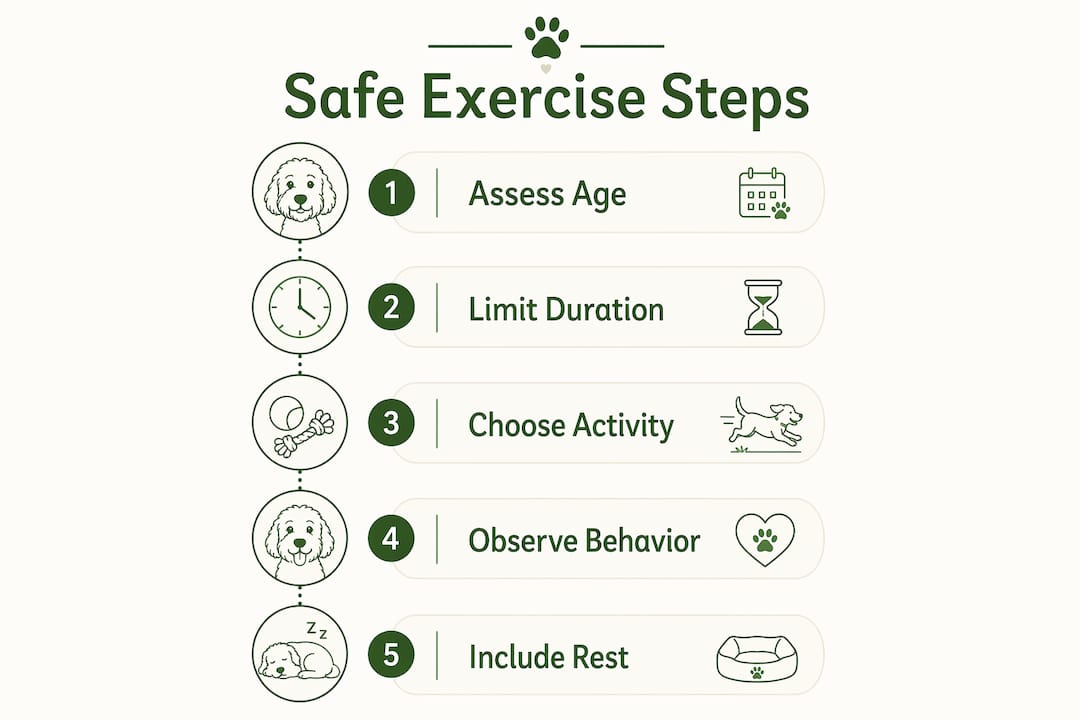
Practical steps that protect your puppy:
- Follow the 5-minute rule strictly. Apply it to all structured activity, including fetch, rough play, and off-leash running. The rule is not just for walks.
- Use crate time intentionally. An overtired puppy needs rest, not redirection. A crate is a recovery tool that prevents the cycle of overstimulation.
- Watch body language during and after exercise. Slowing down, lagging behind, or sitting mid-walk are signals to stop immediately.
- Choose soft surfaces when possible. Grass and dirt absorb impact better than pavement. Avoid long runs on concrete until growth plates close.
- Consult your vet before increasing intensity. Any jump in exercise duration or type should be cleared, especially for puppies showing any joint sensitivity.
The comparison below shows how structured versus unstructured exercise affects puppy outcomes:
| Approach | Joint impact | Behavior outcome |
|---|---|---|
| Structured, age-limited walks | Low risk, supports healthy growth | Calmer, more settled puppy |
| Free-running without limits | High risk of growth plate damage | Hyperactivity and poor self-regulation |
| Mental exercise only | No joint impact | Mentally tired, physically rested |
| Combination of mental and physical | Balanced load | Best overall behavior and health |
Caring for a growing doodle means reading your puppy’s signals every day. The caring for your dog resource from Lakewoodranchdoodles covers long-term musculoskeletal health in plain language for new owners.
Key Takeaways
Doodle puppies need structured, age-limited exercise to protect their growth plates and build the calm, healthy behavior that lasts into adulthood.
| Point | Details |
|---|---|
| Follow the 5-minute rule | Limit walks to 5 minutes per month of age, twice daily, until growth plates close. |
| Growth plate closure varies by size | Minis close at 10–12 months; standards close at 15–18 months. Adjust exercise accordingly. |
| Over-exercise causes silent damage | Growth plates lack pain receptors, so injury accumulates before any limp appears. |
| Mental exercise reduces physical load | Fifteen minutes of training or puzzle work can replace 45 minutes of physical activity safely. |
| Consistency outperforms intensity | Daily short walks protect joints better than occasional long or intense sessions. |
What I have learned after 20 years of raising doodle puppies
The hardest conversation I have with new puppy owners is the one about slowing down. They bring home this bouncy, joyful puppy and want to give it everything. Long hikes, fetch in the yard, trips to the dog park every weekend. The energy is contagious, and the instinct to match it is completely natural.
But I have seen what happens when owners follow the puppy’s lead instead of the biology. A puppy that runs hard at four months may be limping at ten. By the time a vet confirms hip dysplasia or a growth plate injury, the damage is already permanent. That is a painful outcome for the dog and a heartbreaking one for the family.
What actually works is boring by comparison. Short walks. Crate rest. Training sessions that last ten minutes. Puzzle feeders at dinner. It does not look like enough, but the results speak for themselves. The puppies raised this way grow into dogs that are easier to train, calmer in the house, and physically sound well into old age.
The other thing I tell every owner: mental exercise is not a consolation prize. It is often more effective than a long walk at settling a wired puppy. Doodles are bred from working lines on both sides. Their brains need a job. Give them one, and the physical exercise requirement becomes much more manageable.
Enjoy this stage. Puppyhood is short. The limits you hold now are the reason your dog runs freely and pain-free at ten years old.
— Lakewood
Healthy doodle puppies start here at Lakewoodranchdoodles
Lakewoodranchdoodles breeds Goldendoodles, Bernadoodles, and Cockapoos with over 20 years of hands-on experience in Lindsay, Ontario. Every puppy leaves with a foundation built on health, temperament, and trainability. We also give new owners the practical guidance they need to raise their puppy right, including age-specific exercise advice from day one.
Whether you are a first-time owner or adding a second dog to your home, our team walks with you through every stage. Browse our available doodle puppies to see current litters, or reach out directly at 705 875 5195 to book a visit or a virtual appointment. We are here to help you get this right from the start.
FAQ
How much exercise does a doodle puppy need per day?
Follow the 5-minute rule: no more than 5 minutes of structured exercise per month of age, twice daily. A 4-month-old puppy gets two 20-minute sessions.
When can I start running or hiking with my doodle?
Wait until growth plates fully close, which happens at 10–18 months depending on your doodle’s size. Starting intense activity before that point risks permanent joint damage.
Are zoomies a sign my puppy needs more exercise?
Zoomies typically signal overtiredness, not unmet exercise needs. Crate rest and enforced downtime calm an overstimulated puppy more effectively than additional play.
Can mental stimulation replace physical exercise for doodle puppies?
Mental exercise reduces how much physical activity a puppy needs. Fifteen minutes of training or puzzle work can tire a doodle as effectively as 45 minutes of physical exercise.
What activities are safest for young doodle puppies?
Short leash walks on soft surfaces, calm sniff games, and brief training sessions are the safest options before growth plates close. Avoid fetch, rough play, and long runs until your puppy reaches full skeletal maturity.