


Socialization during the 3–14 week sensitive window is the single most powerful thing you can do for your puppy’s lifelong temperament. Miss it, and you’re not just dealing with a shy dog — you’re looking at a real risk of fear-based aggression, anxiety, and behavioral problems that can be difficult or impossible to fully reverse.
Two things to do today:
- Call your veterinarian and ask about safe socialization options given your puppy’s current vaccination status.
- Identify a clean, vaccine-required puppy class in your area, or plan three supervised, low-stress exposures at home this week.
Table of Contents
- Why early socialization matters for puppies
- What the research actually shows about puppy classes
- What counts as good socialization?
- How to socialize safely before full vaccination
- A simple P.L.A.N. schedule for weeks 3–14
- Red flags and when to get professional help
- Socialization doesn’t stop at 14 weeks
- Key Takeaways
- A breeder’s perspective on what actually works
- Trusted sources and where to find certified professionals
Why early socialization matters for puppies
The sensitive period for social learning in puppies runs from roughly 3 to 14 weeks of age. Some veterinary sources suggest it may extend up to 16 weeks, but most place the window at 3–14 weeks. During this window, a puppy’s brain is wired to absorb new experiences with curiosity rather than fear. That balance flips as the weeks pass. By 12–14 weeks, fear learning accelerates and habituation becomes harder.
The practical implication: every week you wait is a week of diminishing returns.
| Age Range | What’s Happening | Socialization Priority |
|---|---|---|
| 3–5 weeks | Eyes and ears open; first social responses | Breeder-led handling and gentle novelty |
| 6–8 weeks | First fear responses emerge; curiosity still dominant | Introduce people, sounds, surfaces |
| 8–12 weeks | Peak window; fear of novelty rising | Puppy class, varied environments, handling |
| 12–14 weeks | Window closing; fear learning dominant | Maintain momentum; avoid stressful firsts |
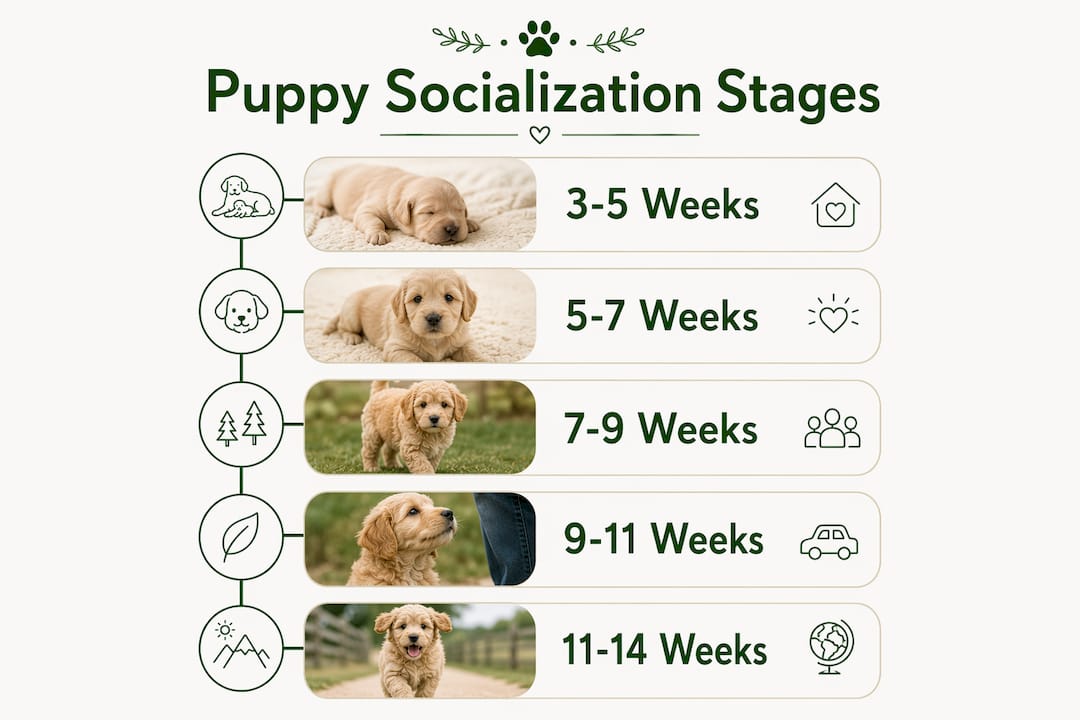
The AVSAB, AVMA, and Ohio State University College of Veterinary Medicine all point to the same conclusion: puppies deprived of varied exposure during this period are at significantly higher risk of permanent fear responses and poor stress coping as adults.
What the research actually shows about puppy classes
The evidence for early socialization is not anecdotal. Puppies that attend early training classes show better response to commands and lower rates of fear and anxiety later in life compared to those with no structured exposure.
Key findings from peer-reviewed research:
- Dogs acquired at 12 weeks or younger had reduced odds of fear, anxiety, and destructive behavior as adults.
- Puppies that attended training during early life showed reduced likelihood of aggression, compulsive behavior, and excessive barking compared to untrained dogs.
- Structured puppy classes with qualified professionals help identify problematic behaviors early, allowing faster intervention.
Behavioral problems are a major cause of death in dogs under 3 years of age, according to the AVSAB position statement. They are also the primary reason dogs are relinquished to shelters. The stakes of skipping socialization are that high.
The AVMA literature review reinforces this: animals deprived of early diverse exposure show higher fearfulness and often need intensive, paced interventions later — interventions that are far more time-consuming and expensive than a puppy class.
What counts as good socialization?
Quality beats quantity every time. A puppy who has ten calm, positive encounters with strangers is better prepared than one who was dragged to a crowded farmer’s market and spent the whole time trembling. VCA Animal Hospitals and the AVMA both emphasize this: forced or fear-inducing exposures can backfire and create the very associations you’re trying to prevent.
Aim to cover these categories before 14 weeks:
- People: different ages, sizes, hats, glasses, uniforms, wheelchairs, umbrellas
- Animals: calm, vaccinated dogs; cats or other household pets the puppy will live with
- Environments: different floor surfaces, outdoor terrain, car rides, crates
- Sounds: vacuum cleaners, traffic, children playing, doorbells, thunderstorm recordings
- Handling: ears, paws, mouth, belly — the kind of touching a vet or groomer will do
Pro Tip: Structure each exposure as treat → novelty → walk away. Let the puppy approach on its own terms, pair the new thing with a high-value treat, then end the session before the puppy shows stress. Watch for pinned ears, tucked tail, yawning, lip-licking, or freezing — those are early stress signals, not curiosity.
How to socialize safely before full vaccination
One of the most persistent myths in puppy ownership is that you must wait until all vaccines are complete before socializing. The AVSAB is direct on this: because the sensitive window closes before most vaccine series are finished, the behavioral risk of waiting often outweighs the infection risk when owners choose low-risk settings.
Safe options:
- Clean, vaccine-required puppy classes (AVSAB advises classes can start as early as 7–8 weeks with at least one vaccine and proper hygiene)
- Supervised visits with vaccinated, healthy dogs you know
- Carrying your puppy in public places where they aren’t walking on unknown ground
- Home visits from vaccinated, healthy people
Avoid:
- Dog parks and pet stores where vaccination status is unknown
- Any setting where sick dogs may have been recently present
- Forcing interactions with dogs or people who make your puppy retreat
Always consult your veterinarian first. Local disease prevalence varies, and your vet can advise on the right timing for your specific area. A puppy vaccination and socialization schedule can help you map vaccine timing to socialization milestones.
A simple P.L.A.N. schedule for weeks 3–14
The P.L.A.N. framework, recommended by veterinary behaviorists and outlined by Ohio State University, stands for: Positive, Low-stress, Appropriate, Not overwhelming. Keep sessions short — several 5–10 minute bursts across the day outperform one long session.
| Weeks | Who Leads | Sample Activities | Session Length |
|---|---|---|---|
| 3–5 | Breeder | Gentle handling, novel textures, soft sounds | 5 min, multiple times daily |
| 6–8 | Breeder + new owner | Carrier outings, one or two calm adults, car ride | 5–10 min |
| 8–10 | New owner + vet-approved class | Puppy class, new surfaces, brief leash walks in low-traffic areas | 10 min max |
| 10–14 | New owner | Children, supervised dog meetings, varied environments, vet-handling practice | 10 min |
Pro Tip: A puppy showing curiosity looks loose and wiggly, with a soft tail wag and forward ears. A puppy showing stress looks stiff, low, or frozen. The moment you see stress, reduce the intensity immediately — don’t push through it.
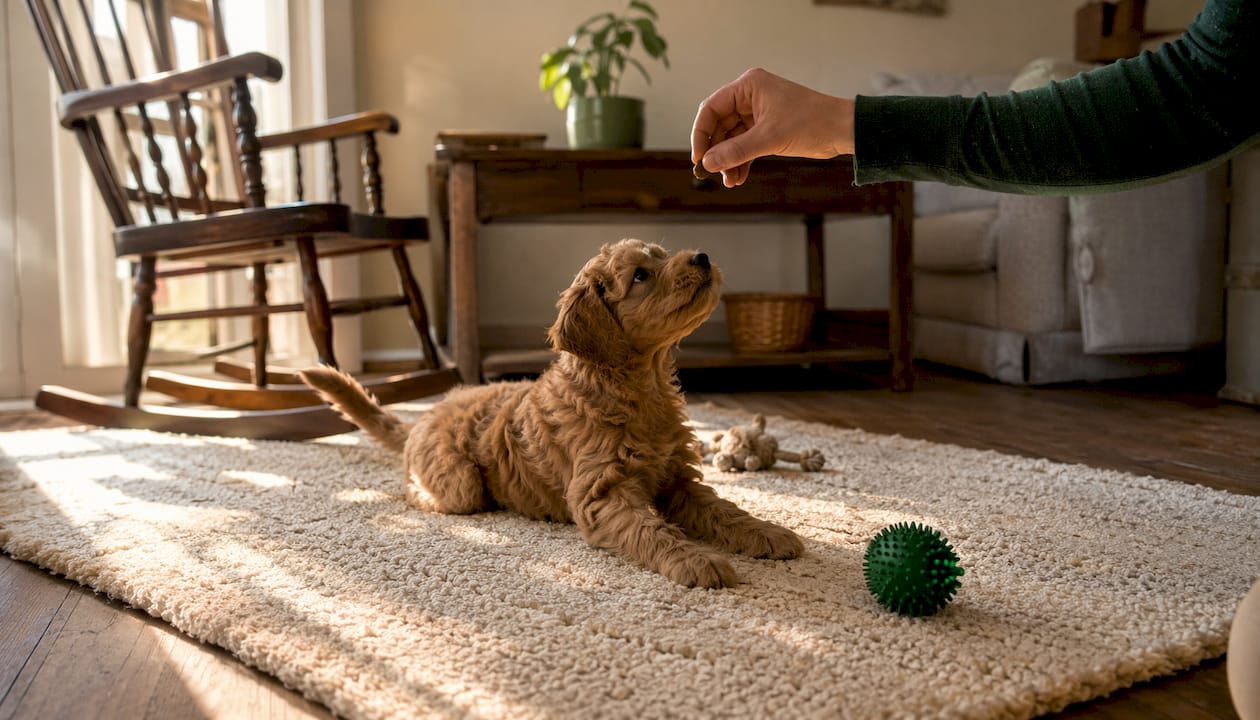
For more on reading body language during doodle puppy introductions, Lakewoodranchdoodles has practical guidance specific to their breeds.
Red flags and when to get professional help
Some puppies need more than a good socialization plan. Knowing when to escalate is as important as knowing how to start.
Watch for these warning signs:
- Persistent freezing or shutting down when exposed to normal, everyday stimuli
- Growling, lunging, or snapping at people or dogs in routine situations
- Panic that escalates rather than settles with gentle exposure
- Refusal to go outside or extreme clinginess that disrupts daily life
- Repetitive, compulsive behaviors (spinning, tail-chasing, excessive licking)
The referral path matters. Start with your veterinarian to rule out pain or medical causes — fear-based behavior sometimes has a physical root. If aggression or safety is involved, ask for a referral to a certified veterinary behaviorist. For milder cases, a credentialed trainer with experience in fear-based work is a reasonable next step. When selecting a trainer, look for credentials, reward-based methods, and experience with anxious dogs specifically.
Group puppy classes are the most affordable option, typically ranging from a few sessions to multi-week programs. Private trainers cost more but offer tailored attention. Veterinary behaviorists are the highest level of care and are appropriate for serious aggression or severe anxiety. Check essential puppy training tips for guidance on evaluating class formats.
Socialization doesn’t stop at 14 weeks
The sensitive period closes, but the work continues. Adolescence, roughly 6–18 months, brings a temporary spike in reactivity that can catch owners off guard. A dog who seemed perfectly social at 10 weeks may suddenly bark at strangers or pull toward other dogs at 8 months. This is normal, and continued positive exposure is what prevents regression.
Low-effort maintenance habits that make a real difference:
- Regular walks on new routes with novel sights and sounds
- Controlled meet-and-greets with calm, known dogs
- Continuing a training class or adding a new skill
- Periodic handling refreshers: paws, ears, mouth, belly
- Brief car rides to places the dog enjoys, not just the vet
A dog who keeps encountering the world in positive, manageable doses stays confident. The signs of a thriving puppy shift as they grow, but the underlying principle stays the same: new experiences paired with calm, positive outcomes build a resilient dog.
Key Takeaways
Early socialization during the 3–14 week sensitive window is the most effective way to reduce fear-based behavior and build a confident, well-adjusted adult dog.
| Point | Details |
|---|---|
| The window is short | The sensitive period runs from 3 to 14 weeks; missing it raises the risk of permanent fear responses. |
| Quality over quantity | Short, positive exposures beat repeated stressful ones; never force a frightened puppy. |
| Socialize before full vaccination | AVSAB-approved puppy classes can start at 7–8 weeks with one vaccine; avoid dog parks. |
| Know when to escalate | Persistent freezing, lunging, or panic warrants a vet visit, then a certified behaviorist or trainer. |
| Keep going through adolescence | Continued positive exposure during 6–18 months prevents reactivity from taking hold. |
One action item: This week, call your vet about vaccination timing and identify a clean, vaccine-required puppy class or schedule three supervised home exposures.
A breeder’s perspective on what actually works
At Lakewoodranchdoodles, socialization starts before a puppy ever meets its new family. From the first weeks of life, every litter gets daily handling: paws touched, ears examined, bellies rubbed. Puppies hear household sounds, ride in cars, and walk on different surfaces before they leave our care. That foundation matters enormously, but it’s only the beginning.
Here’s what 20+ years of raising service-quality temperaments has taught us:
- Breeders set the floor, owners build the house. What we do in those early weeks gives your puppy a head start, but the window stays open after you bring them home. Don’t assume the work is done.
- The biggest owner mistake is waiting for “the right moment.” There is no perfect moment. A puppy carried to a quiet coffee shop patio at 9 weeks is getting socialization. A puppy sitting at home waiting for all vaccines is losing time.
- Short and sweet beats long and thorough. Five minutes of calm novelty twice a day does more than a two-hour outing that ends in exhaustion.
- Read your puppy, not your schedule. If your puppy is shutting down, the session is over. Full stop.
- Lifetime support is part of what we offer. If you’re unsure whether what you’re seeing is normal, reach out. Our puppy socialization guide is a practical starting point, and we’re available by phone at 705 875 5195 or by appointment for virtual visits.
If you’re looking for a puppy that’s already had a strong socialization foundation from day one, our Goldendoodle puppies, Bernadoodle puppies, and Cockapoo puppies are raised with exactly this approach. 
Trusted sources and where to find certified professionals
These are the primary resources referenced throughout this article, all worth bookmarking:
- AVSAB Puppy Socialization Position Statement: The definitive veterinary behavior organization’s guidance on timing, safe settings, and the stakes of missing the window.
- AVMA Socialization Literature Review: A thorough summary of peer-reviewed evidence on early exposure and long-term behavioral outcomes.
- VCA Animal Hospitals: Socialization and Fear Prevention: Practical, owner-facing guidance on quality exposures and reading puppy body language.
- Ohio State University College of Veterinary Medicine: Detailed guidance on balancing infection risk with behavioral development, including the P.L.A.N. framework.
- Lakewoodranchdoodles Training Resources: Practical owner-facing training support and lifetime breeder guidance.
To find a certified professional, look for a veterinary behaviorist (Diplomate of the American College of Veterinary Behaviorists) for serious cases, or a trainer certified through the Certification Council for Professional Dog Trainers (CCPDT) for class-based work. Always ask about their experience with fear-based cases specifically, and confirm they use reward-based methods. Your veterinarian is the right first call — they can refer you to the appropriate level of care for what you’re seeing.