


Doodles respond well to training because they inherit the Poodle’s problem-solving drive alongside the social eagerness of retrievers and spaniels, and reputable breeders like Lakewoodranchdoodles reinforce those traits through deliberate temperament selection and early handling. That combination is genuinely rare in a single dog.
Three things drive it:
- Intelligence and biddability. Poodles consistently rank among the most cognitively capable breeds, and that problem-solving ability passes directly to their crosses. Doodles pick up new behaviors fast.
- Social reward motivation. The retriever and spaniel lines that pair with Poodles in most doodle crosses are wired to seek human approval. Your praise and attention are currency to them.
- Breeder selection and early socialization. A breeder who screens for calm, curious temperaments and handles pups daily from birth gives you a puppy already primed to engage with training before you ever bring it home.
The sections below unpack the genetics behind those traits, walk through the most common training pitfalls, and give you a concrete age-progressive schedule you can start using this week.
Key Takeaways
Doodles respond well to training because they combine Poodle intelligence with retriever/spaniel social motivation, and that advantage compounds when a breeder invests in early socialization and temperament selection.
| Point | Details |
|---|---|
| Genetics drive trainability | Poodle problem-solving plus retriever/spaniel biddability creates fast, motivated learners across doodle varieties. |
| Socialization window is critical | The 3–14 week window shapes fear response and adaptability; missing it creates reactivity that takes months to address. |
| Short, frequent sessions work best | Puppy sessions of 5–10 minutes, ending on a success, outperform long sessions for doodle-type dogs. |
| “Stubbornness” is usually boredom | Increase mental enrichment and standardize household cues before assuming a behavior problem is temperament-based. |
| Lakewoodranchdoodles breeds for this | Temperament selection, daily handling from birth, and lifetime breeder support give buyers a head start on training. |
Table of Contents
- Why doodles respond well to training: genetics and temperament
- Common training problems doodle owners run into
- What training methods actually work for doodles
- A breeder-recommended training schedule by age
- When should you hire a trainer or behaviorist?
- What we see in well-bred, well-socialized doodles
- Lakewoodranchdoodles breeds doodles built for training success
- Sources
Why doodles respond well to training: genetics and temperament
The short answer is that doodles are a deliberate genetic overlap between two high-drive, people-oriented lineages. Breed-focused resources confirm that doodles combine the Poodle’s problem-solving ability with the social, biddable traits of retriever and spaniel parents, which explains both rapid learning and a real sensitivity to boredom.
What each parent line contributes:
- Poodle: Ranked second in Stanley Coren’s canine intelligence research, Poodles learn new commands in very few repetitions. They also get bored quickly when tasks are repetitive or too easy.
- Golden Retriever / Labrador Retriever: Bred to work closely with humans, these lines bring low independence and high social motivation. A Goldendoodle or Labradoodle typically wants to be near you and wants to get things right.
- Bernese Mountain Dog: Calmer and more patient than retriever crosses, Bernedoodles often show steadier focus during sessions, though they can be slower to warm up to strangers.
- Cocker Spaniel / Cavalier: Cockapoos carry scent-drive and a slightly more independent streak. They respond beautifully to positive reinforcement but may need shorter sessions and more variety.
Breed-mix variability matters more than most owners expect. An F1 Goldendoodle (Poodle × Golden Retriever) typically shows higher biddability and social calm than an F1b Cockapoo, which may retain more scent-driven, independent behaviors. Adapt your reward types and enrichment accordingly.
Breeder selection amplifies all of this. When a breeder screens parent dogs for stable temperaments, handles pups daily from birth, and exposes litters to sounds, textures, and gentle handling before eight weeks, the puppies arrive at your home with a head start. AVSAB recommends intensive early socialization during the primary socialization window (roughly 3–14 weeks) to reduce fear and improve adaptability. A breeder who takes that window seriously is doing a significant portion of your training work before you even meet the puppy.
Pro Tip: Before you commit to a puppy, ask the breeder how pups are handled from birth through eight weeks. Daily human contact, exposure to household sounds, and varied surfaces during that window predict trainability far better than coat color or generation label.
The socialization window (3–14 weeks) is the single highest-leverage period in a doodle’s development. Pups exposed to many people, sounds, and environments during this phase show measurably lower fear-based reactivity later. Miss it and you spend months catching up.
Many breed and training sites also report that doodles succeed in therapy, service, and agility work when early socialization and structured training are combined. The ceiling is high when the foundation is right.
Common training problems doodle owners run into
Most doodle “problems” are misread. Owners describe stubbornness, distraction, reactivity, or separation anxiety as personality flaws. Trainers usually see something more specific and fixable.
What owners report and what it usually means:
- Appears stubborn or ignores cues. Almost always boredom or inconsistent household rules, not defiance. Doodle-focused guides note that what looks like stubbornness is typically intellectual frustration or mixed signals from different family members using different cues.
- Easily distracted outdoors. The behavior was never proofed in that environment. A dog that sits perfectly in your kitchen has learned “sit in the kitchen,” not “sit everywhere.”
- Reactive on leash. Usually fear or overstimulation, not aggression. Doodles that missed the socialization window or had limited exposure to traffic, dogs, or crowds often react from anxiety rather than dominance.
- Separation anxiety. Common in highly social doodles who were never taught that being alone is safe. It shows up as destructive behavior, vocalization, or house-training regression when left alone.
- Mouthiness in puppies. Normal puppy behavior, but doodles with high play drive can be persistent. Redirecting to a toy and removing attention consistently resolves it faster than correction. See how to stop doodle puppy biting for a step-by-step approach.
Why punishment backfires with doodles. Sensitive doodles, particularly those with strong retriever or spaniel lines, shut down under aversive methods. AVSAB’s position is clear: punishment-based approaches risk worsening fear- and anxiety-driven behaviors rather than resolving them. A doodle that stops a behavior because it’s scared is not a trained dog. It’s a dog waiting for the pressure to lift.
Pro Tip: To diagnose a problem behavior, ask three questions: Is the dog getting enough mental work? Are all household members using the same cues? Has this behavior ever been accidentally rewarded? The answer to at least one of those is almost always yes.
What training methods actually work for doodles
Positive reinforcement plus predictable routine plus mental enrichment. That combination produces the most reliable results with doodle-type dogs, and the research and trainer consensus back it up consistently.
Using a marker and high-value rewards
Marker training, using a clicker or a consistent verbal “yes,” accelerates precise behavior shaping in poodle crosses because it tells the dog exactly which movement earned the reward. Experienced owners report faster initial acquisition with marker training than with verbal praise alone.
- Choose your marker: a clicker or the word “yes” said in a flat, consistent tone.
- Charge the marker first: click/say “yes,” then immediately deliver a treat, 10–15 times in a row, until the dog’s ears perk at the sound.
- Select high-value rewards: small pieces of real chicken, cheese, or commercial training treats that the dog doesn’t get any other time.
- Keep sessions to 5–10 minutes for puppies, 10–15 minutes for adults. Dogster’s trainer-verified guidance confirms that short, frequent sessions outperform long ones for doodle-type dogs.
- End every session on a success, even if that means asking for something easy.
Proofing behaviors in real-world distraction
Teaching a behavior in your living room is step one. Getting reliable performance at the park, at the vet, or around other dogs is a separate project. Bark Busters’ Goldendoodle notes highlight that even eager-to-please Goldendoodles need deliberate proofing to generalize behaviors outside the home.
- Add one new variable at a time: a new room, then the backyard, then the sidewalk, then a quiet park.
- Drop your criteria slightly when you add distraction. If the dog knows a 30-second sit in the kitchen, ask for a 5-second sit outside first.
- Use a “jackpot” reward (several treats delivered rapidly) for a correct response in a genuinely hard environment.
- Practice recall daily. Call the dog from another room, reward generously, and never call the dog to you for something unpleasant.
Mental enrichment as a training tool
Puzzle feeders, sniff mats, and trick training are not extras. For a dog with Poodle-level problem-solving drive, mental work is as tiring as physical exercise, and a mentally tired doodle is a focused doodle. Check out doodle puppy mental stimulation activities for a daily plan you can rotate through.
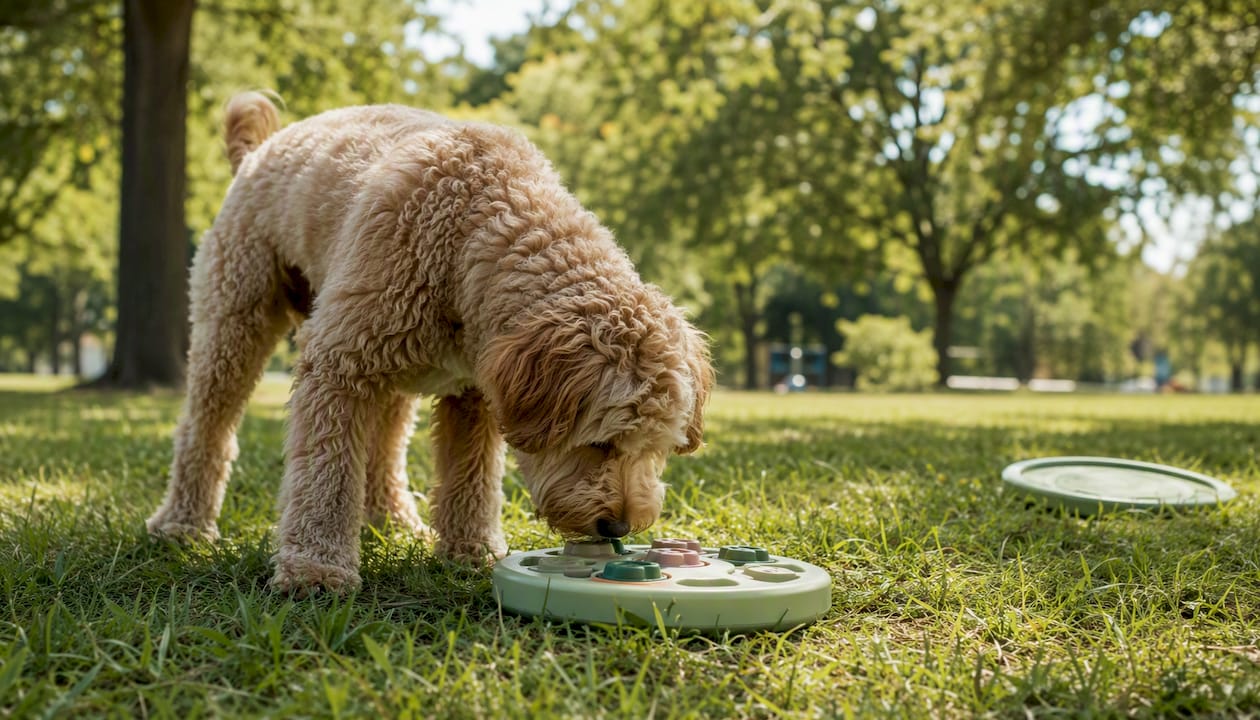
Pro Tip: Mix your reward types. Food rewards build speed and precision. Social rewards (play, praise, a quick game of tug) build duration and enthusiasm. Life rewards (opening the door, clipping the leash for a walk) teach the dog that good behavior pays off in real-world currency, not just treats.
Adolescence (roughly 6–18 months) brings a regression phase. Behaviors that seemed solid will wobble. This is normal neurological development, not a training failure. Increase mental enrichment, shorten sessions, and proof known behaviors in new places rather than introducing too many new commands at once.
A breeder-recommended training schedule by age
The AKC’s Canine Good Citizen program provides a useful benchmark for reliable obedience, and the schedule below maps to those standards across three developmental stages.
| Age Band | Daily Focus | Weekly Focus |
|---|---|---|
| 8–12 weeks | Crate comfort, name recognition, sit, hand-feeding meals | Socialization outings (3–5 per week), puppy class enrollment |
| 4–12 months | Sit, down, stay, loose-leash walking, recall, impulse control | Proofing in new environments, introducing puzzle feeders, CGC skill practice |
| 1+ year | Proofing all CGC behaviors in public, trick training, off-leash recall | Agility, therapy prep, or advanced obedience depending on the dog’s drive |
Step-by-step exercises to pair with the schedule:
- Crate training (8–12 weeks). Feed all meals in the crate with the door open. Gradually close the door for short periods while you stay in the room. Build duration before distance.
- Recall drills (start at 10 weeks). Call the dog’s name, crouch down, reward with the best treat you have. Never punish a dog that comes to you slowly.
- Impulse control (12 weeks onward). “It’s Yer Choice” by Susan Garrett: hold a treat in your closed fist. Wait for the dog to stop pawing and nosing, then open your hand. The dog learns that backing off earns the reward.
- Environmental proofing (ongoing). Take the dog somewhere new at least twice a week. Practice one known behavior in that location before asking for anything new.
- Enrichment rotation. Rotate puzzle feeders, sniff mats, frozen Kongs, and training games so the dog doesn’t habituate to any single activity.
Pro Tip: For higher-energy doodles (many F1 Goldendoodles and Labradoodles), add a 10-minute sniff walk before each training session. Letting the dog use its nose first reduces arousal and improves focus during the session itself.
For socializing your doodle puppy with other dogs safely and effectively, the key is controlled, positive exposures rather than overwhelming dog-park free-for-alls.
When should you hire a trainer or behaviorist?
Most doodle owners can handle basic obedience at home with consistency and the right methods. A few situations genuinely call for professional help.
Seek professional support when:
- A behavior has lasted more than four weeks despite consistent, correct handling.
- The dog shows fear responses (tucked tail, whale eye, freezing, growling) that are escalating rather than improving.
- There is any bite history, even a warning snap.
- Separation anxiety is severe enough to cause self-injury or property destruction.
- You’ve made no measurable progress after six weeks of structured home training.
Choosing the right professional:
- Reward-based trainer: Best for basic obedience, manners, and mild behavior issues. Look for CPDT-KA (Certified Professional Dog Trainer) credentials.
- Behavior consultant (CDBC or IAABC member): Best for moderate anxiety, reactivity, or multi-dog household conflicts.
- Veterinary behaviorist (DACVB): A board-certified veterinary specialist. Best for severe anxiety, compulsive behaviors, or cases where medication may be part of the plan.
Questions to ask any trainer before you hire them:
- What methods do you use, and do you use aversive tools (prong collars, e-collars, leash corrections)?
- Do you have experience specifically with doodle breeds or poodle crosses?
- What credentials do you hold, and are you a member of a professional organization?
- How do you measure progress, and what does a typical training plan look like?
- Can you provide references from clients with similar breeds or issues?
Walk away from any trainer who cannot explain their methods clearly, dismisses your questions, or relies primarily on corrections and dominance theory. Doodles trained with aversive methods often develop anxiety that takes longer to resolve than the original problem. Lakewoodranchdoodles maintains a trainer resource page for buyers who want vetted referrals.
What we see in well-bred, well-socialized doodles
At Lakewoodranchdoodles, we’ve watched hundreds of puppies grow from their first days in the whelping box through adulthood, and the pattern in well-bred, well-socialized doodles is consistent. These dogs are socially motivated in a way that makes training feel collaborative rather than coercive. They want to figure out what earns the reward. They read human body language well, which means they often anticipate cues before you’ve finished giving them.
The puppies we handle daily from birth, expose to varied sounds and surfaces, and socialize intentionally during that 3–14 week window tend to show faster recall acquisition and lower reactivity when owners follow through with structured training. Several have gone on to therapy work, which requires a dog that can stay calm and focused in genuinely unpredictable environments. That outcome isn’t luck. It’s the result of deliberate breeding decisions stacked on top of early handling.
The training guidance on our website reflects what we’ve seen work across more than 20 years of breeding for service-quality temperaments.
Lakewoodranchdoodles breeds doodles built for training success
If you want a doodle that arrives home already primed to learn, the foundation starts with the breeder. Lakewoodranchdoodles selects parent dogs for stable, social temperaments, handles every litter daily from birth, and begins socialization during the critical 3–14 week window before puppies ever leave the ranch. That early work is what separates a dog that picks up “sit” in two sessions from one that takes two months.
Every puppy comes with lifetime breeder support, so you’re never figuring out a training challenge alone. Whether you’re looking at Goldendoodle puppies, Bernedoodles, or Cockapoos, each litter is bred with trainability and health as the primary goals. View available puppies or call 705-875-5195 to schedule a visit and see the temperament work firsthand.
Sources
These are the primary sources behind this guide, each worth bookmarking for different reasons.
- AVSAB
- Canine Good Citizen — AKC
- How to Train a Labradoodle: 11 Vet-Verified Tips & Tricks — Dogster
- How to Train a Labradoodle: Tips From Experienced Doodle Owners | Labradoodle House
- Training a Doodle - All About The Doodle
The most important thing any of these sources agree on: start early, stay consistent, and make training worth the dog’s time. A doodle that finds learning rewarding will keep learning for its entire life.