


Recall training is the practice of teaching your dog to stop what it’s doing and come directly to you when called. Start right now with a one-minute indoor drill: say your dog’s name once, crouch down, and reward with the highest-value treat your dog knows the moment it reaches you. That’s the foundation. According to UC Davis Veterinary Medicine, the AKC, and the breeder team at Lakewoodranchdoodles, this single behavior is the most important skill you will ever teach your dog.
Here’s what you need to know before you start:
- Recall is a trained behavior, not a personality trait. Any dog can learn it.
- Positive reinforcement, not punishment, is the only method that builds a reliable response.
- Progress is measured in thousands of successful repetitions, not days.
Table of Contents
- Why does recall training matter so much?
- What does a reliable recall actually look like?
- How to teach dog recall: the step-by-step progression
- Recall games that build speed and motivation
- Common mistakes and how to fix them
- How long does recall training take?
- Puppy-specific recall tips from breeders and trainers
- Key Takeaways
- The part most owners get wrong
- Ready to start with a puppy built for trainability?
- Authoritative sources and further reading
Why does recall training matter so much?
A dog that comes when called is a dog that stays alive. That’s not an exaggeration. Off-leash dogs face real, immediate dangers: traffic, aggressive dogs, wildlife, open water, and toxic plants. A single reliable recall can pull your dog back from a road before a car rounds the corner.
Beyond safety, recall unlocks a better quality of life for your dog. Off-leash time in parks, trails, and open fields is genuinely enriching. Dogs that can run freely, sniff, and explore are calmer, healthier, and better behaved at home. Recall is what makes that freedom possible.
There’s a social dimension too. UC Davis frames recall as a matter of social responsibility: a dog you can call back protects other people, other dogs, and wildlife from unwanted contact. A dog charging at a child or a leashed reactive dog is a liability, even when your dog is friendly.
- Safety: Prevents access to roads, aggressive animals, and hazards.
- Freedom: Enables off-leash parks, hikes, and beach trips.
- Social responsibility: Reduces bite risk and unwanted interactions.
- Relationship: Returning to you becomes a positive, reinforced habit rather than a punishment.
Think of it this way: a dog that has never been taught to come when called isn’t being disobedient. It’s just doing what comes naturally. Recall is a skill you build together.
What does a reliable recall actually look like?
The AKC defines a reliable recall as one you are 99.99% confident will succeed. That’s the target. In practice, it means your dog turns away from whatever it’s doing, moves toward you with speed and enthusiasm, and arrives close enough to touch.
The AKC’s standard: A reliable recall is one where you are 99.99% sure your dog will come. No dog is truly 100% perfect in every situation.
Realistic limits matter here. Even a well-trained dog can be overridden by:
- High prey drive: A squirrel or rabbit can short-circuit even months of training.
- Extreme distractions: Crowds, other dogs playing, strong scents.
- Age and health: Young puppies have short attention spans; older dogs may have hearing loss.
- Handler inconsistency: Calling the dog when you know it won’t come poisons the cue over time.
- Context: A dog reliable in your backyard may struggle at a busy dog park.
Set your expectations accordingly. The goal is a recall that works in the situations you actually encounter, built up gradually through controlled practice. A dog that comes when called in a moderately distracting park is a genuine achievement worth celebrating.
How to teach dog recall: the step-by-step progression
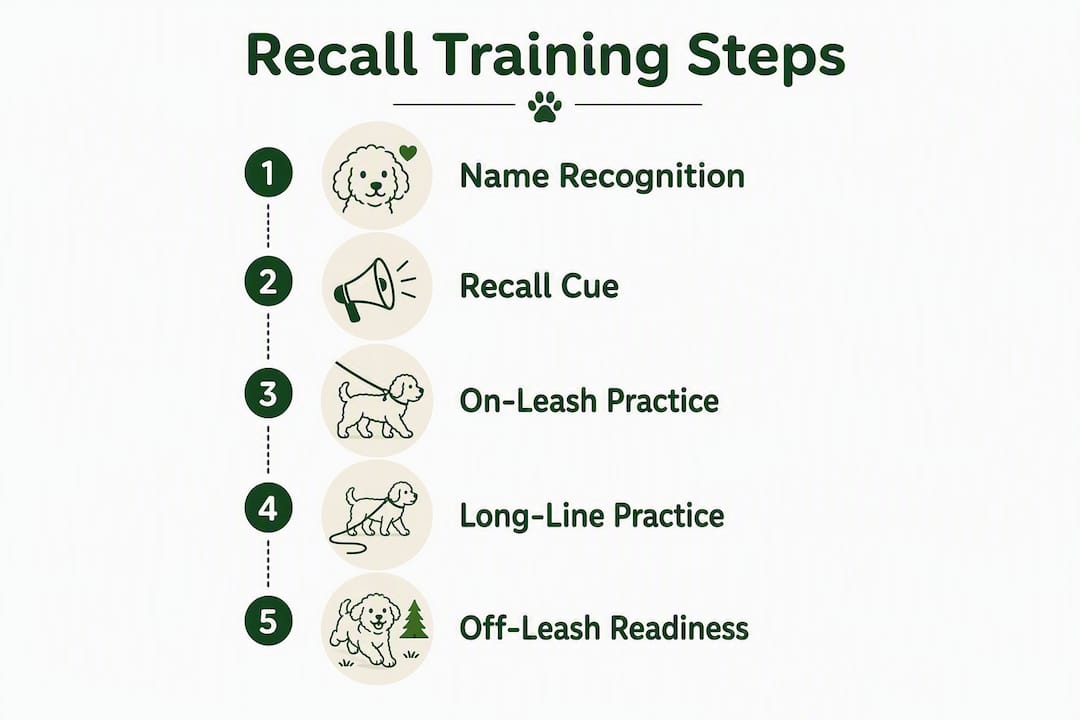
This is the progression that UC Davis and the AKC both recommend: start inside, add distance, add distraction, then earn off-leash freedom one environment at a time.
Step 1: Name recognition and attention indoors
Before your dog can recall, it needs to know its name means “look at me.” Purina recommends starting with name recognition and a marker word (“Yes!” or a clicker) before introducing the recall cue. Say the name once, mark the moment your dog looks at you, and reward. Ten reps, twice a day. That’s it.
Step 2: Introduce the recall cue
Only introduce “come” (or a whistle) once your dog is already moving toward you reliably. Say the cue once, in a happy tone, as the dog is already turning your way. Never say it when the dog is distracted and likely to ignore it. That single mistake is how the word loses its power.
Step 3: On-leash practice at short distances
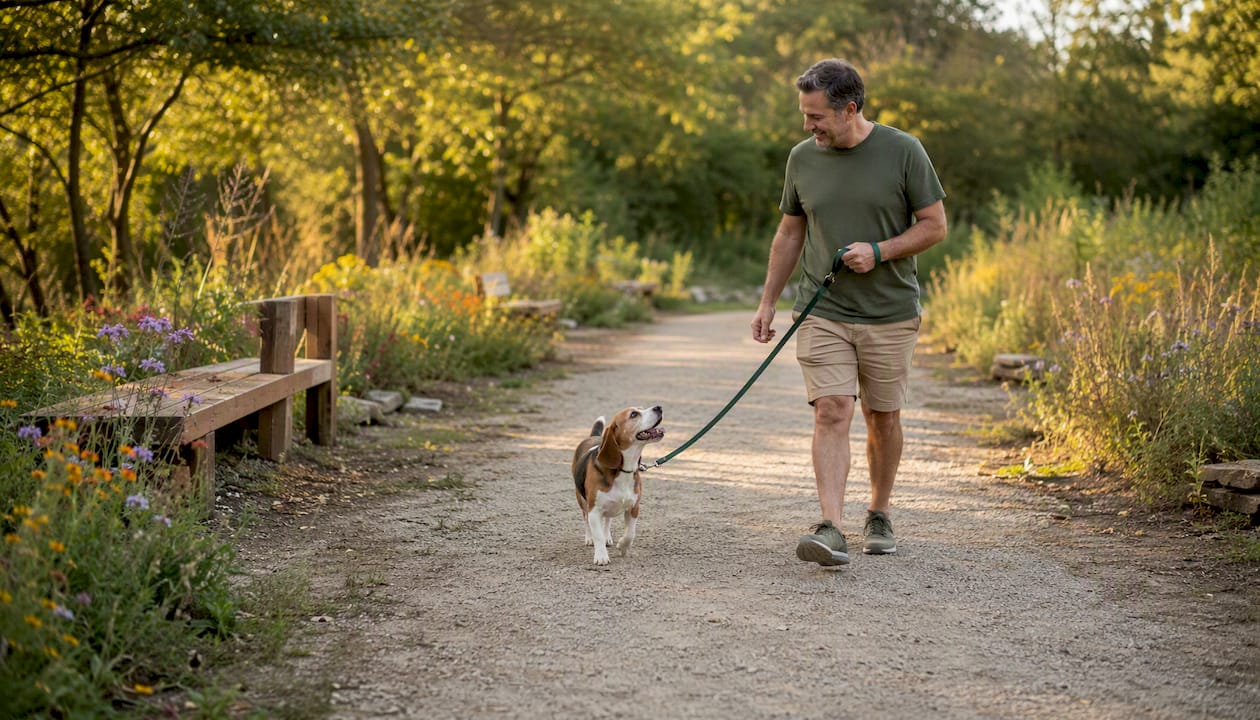
With a 6-foot leash attached, back away from your dog, say “come” once, and reward generously when it arrives. Keep sessions under five minutes. Never repeat the cue if the dog doesn’t respond; instead, gently guide with the leash and reward anyway, then make the next rep easier.
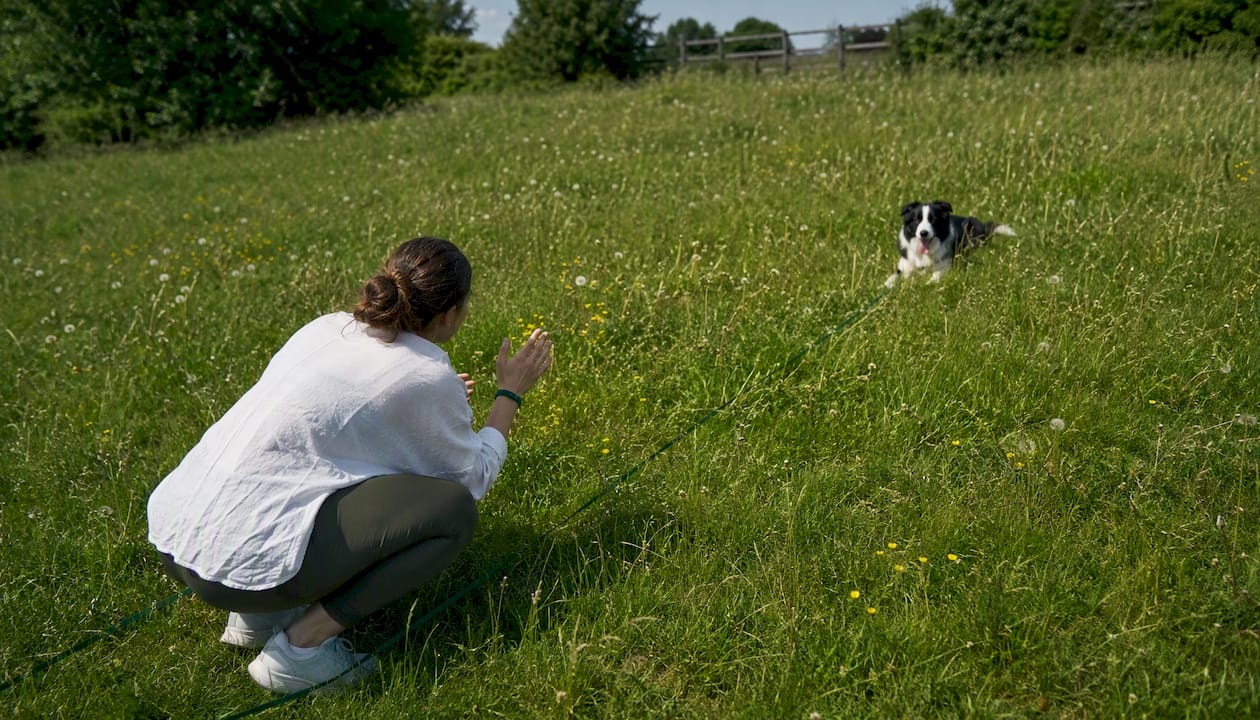
Step 4: Long-line practice with a long lightweight leash giving your dog the feeling of freedom while keeping control
A long-line is a lightweight leash, typically 15–30 feet, that gives your dog the feeling of freedom while keeping you in control. Practice recall at increasing distances. If the dog ignores the cue, use the long-line to guide it toward you without repeating the command. Reward when it arrives. Retractable leashes are not a substitute; they teach dogs to pull and give you no real control.
Step 5: Off-leash readiness
RSPCA guidance is clear: aim for high reliability on the long-line in highly distracting environments before removing it. That benchmark is your green light. Off-leash practice should start in a fully enclosed area, then expand to low-traffic open spaces, then busier ones.
One variable at a time. When you increase distance, keep distractions low. When you add distractions, shorten the distance. Never push both at once.
Pro Tip: Only call your dog when you have a high chance of success. Every failed recall weakens the cue. If you’re not confident, go get your dog instead of calling.
Recall training progression at a glance
| Stage | Environment | Tool | Success Criteria |
|---|---|---|---|
| Name recognition | Indoors, quiet | Treats, marker word | Dog looks at you every time |
| Recall cue introduction | Indoors | Treats | Dog moves toward you on first cue |
| On-leash practice | Yard or quiet room | 6-foot leash | Reliable at 6–10 feet |
| Long-line practice | Yard, then park | 15–30 ft long-line | High reliability in distracting areas |
| Off-leash | Enclosed area first | None | Consistent, enthusiastic response |
Recall games that build speed and motivation
Training doesn’t have to feel like drilling. These games make coming back to you the most exciting option your dog has.
- The chase game: Run away from your dog, calling its name in a high, excited voice. Most dogs can’t resist chasing. UC Davis specifically recommends running away rather than chasing your dog, since chasing teaches the dog to run from you.
- Hide and seek: Hide in another room or behind a tree, then call your dog. The search adds excitement and the find gets a jackpot reward.
- Stair recall: Stand at the bottom of the stairs, call your dog from the top. The physical effort and the reward at the bottom build speed and enthusiasm.
- Toss and recall: Toss a treat away from you, let the dog eat it, then immediately call it back. Repeat. This teaches the dog that leaving you is always followed by a reason to return.
- Intermittent release: During off-leash play, call your dog, reward it, then release it to play again. This is critical. If you only call at the end of play, the recall cue becomes a signal that fun is over. Calling and releasing randomly keeps the cue neutral and the dog willing.
Running a stair recall drill: Put your dog at the top of the stairs. Walk to the bottom. Say “come” once in a bright, happy voice. The moment your dog reaches you, deliver three to five small treats in quick succession (a “jackpot”). Do three reps, then stop. Short, successful, and fun.
For toy-motivated dogs, swap the treat for a quick tug game. The reward should be whatever your dog finds most exciting in that moment.
Common mistakes and how to fix them
Most recall problems come from a handful of owner habits, not from a stubborn or untrainable dog.
The biggest mistakes:
- Repeating the cue. Saying “come, come, COME” teaches your dog that the first call is optional. Say it once.
- Punishing a slow return. The AKC is explicit: never punish a dog for coming to you, even if it took three minutes. Punishment makes the next recall less likely, not more.
- Only calling to end fun. If “come” always means “leash on, car ride home,” your dog will learn to avoid it. Call, reward, and release back to play regularly.
- Using a retractable leash. It gives the dog no clear boundary and you no real control during practice.
- Calling when you know it won’t work. Every ignored recall is a training setback.
What to do when your dog ignores the recall:
- Stay calm. Do not repeat the cue.
- Walk calmly toward your dog. Do not chase.
- Clip the leash on without any fuss or frustration.
- Go back to an easier environment and rebuild from there.
- Ask yourself: was the distraction too high? Was the reward high enough? Was the dog tired or overstimulated?
The MSPCA-Angell recommends varying rewards by dog. Some dogs work harder for a piece of chicken than for kibble. Some prefer a quick game of tug. Know what your dog’s top-tier reward is and save it exclusively for recall.
How long does recall training take?
There’s no honest single answer. Breed, age, prior learning history, and how consistently you practice all shape the timeline. A Goldendoodle puppy starting at 8 weeks with daily sessions will look very different from a 3-year-old rescue dog with a history of roaming.
What UC Davis emphasizes is this: reliable recall is built through thousands of successful repetitions. That’s not discouraging; it’s clarifying. You’re not trying to teach a concept in a week. You’re building a reflex over months.
Practical milestones:
- Week 1–2: Dog responds to name and looks at you reliably indoors.
- Week 3–4: Dog comes on cue indoors and in a quiet yard.
- Month 2–3: Reliable on-leash recall at 10–20 feet in moderate distraction.
- Month 3–6: Reliable recall on long-line in distracting environments.
- Month 6+: Off-leash readiness in enclosed areas; ongoing maintenance in new environments.
| Practice format | Recommended frequency | Session length |
|---|---|---|
| Indoor name recognition | 2–3 times daily | 2–3 minutes |
| On-leash recall | Once daily | 5 minutes |
| Long-line practice | 4–5 times per week | 5–10 minutes |
| Recall games | Daily or every other day | 5 minutes |
Short sessions beat long ones every time. A dog that ends a session wanting more will come back to training with enthusiasm. A dog that’s drilled for 30 minutes will start avoiding the training space.
Puppy-specific recall tips from breeders and trainers
Puppies have a biological head start: young dogs are naturally inclined to follow their people. That window closes. Use it.
Early socialization and puppy training both reinforce the same principle: the habits you build in the first 16 weeks are the ones that stick. Recall is no different.
Puppy recall checklist:
- Play the “gotcha” game — Reach for your puppy’s collar, say “gotcha” in a happy voice, give a treat. The AKC recommends pairing collar grabs with rewards early so the puppy never learns to dodge when you need to clip a leash. This one habit prevents a frustrating problem that develops in many adolescent dogs.
Pro Tip: Never call a puppy to you for something unpleasant, like a bath or nail trim, until the recall is very strong. Go get the puppy instead. Protect the cue.
MSPCA-Angell notes that different puppies respond to different motivators. Some are food-driven; others are toy-driven or praise-driven. Figure out your puppy’s currency early and use it strategically.
Key Takeaways
A reliable recall is built through consistent, positive, low-distraction repetitions that gradually expand to real-world environments, never through punishment or rushed off-leash exposure.
| Point | Details |
|---|---|
| Start indoors, always | Build the cue in a quiet space before adding any distraction or distance. |
| Never punish a return | Even a slow or late recall must be rewarded; punishment kills future responses. |
| Long-line rule | Achieve high reliability on a long-line in distracting areas before going off-leash. |
| Protect the cue | Only call when success is likely; every ignored recall weakens the word. |
| Lakewoodranchdoodles support | Lakewoodranchdoodles provides lifetime breeder guidance and puppy starter resources to help owners build recall from day one. |
The part most owners get wrong
The conventional wisdom on recall training focuses almost entirely on technique: use high-value treats, say the cue once, don’t punish. All of that is correct. But the piece that actually determines whether recall holds up in the real world is something most guides bury in a footnote: relationship.
A dog that genuinely wants to be near you comes back faster, more reliably, and with more enthusiasm than a dog that’s simply been conditioned to respond to a word. That relationship is built in the small moments: the games, the calm handling, the times you called and then released back to play instead of ending the fun. Every one of those moments is a deposit.
The other thing owners consistently underestimate is how long it takes to proof a recall against real distractions. Six months of daily practice is not unusual before a dog is genuinely reliable off-leash in a busy park. That’s not a failure. That’s what the science says it takes. Owners who rush to off-leash freedom before the foundation is solid are the ones who end up with a dog that “used to come” and now doesn’t.
Lakewoodranchdoodles has spent over 20 years watching this pattern play out. The owners who succeed are the ones who treat recall as a lifelong practice, not a box to check.
Ready to start with a puppy built for trainability?
Recall training works best when it starts early, and it works even better when the puppy you’re starting with has been bred for temperament, socialization, and trainability from day one.
Lakewoodranchdoodles breeds Goldendoodles, Bernedoodles, Cockapoos, and occasional Moyen Poodles and Golden Retrievers with service-animal quality temperaments and over 20 years of hands-on experience behind every litter. Every puppy leaves with a foundation of early handling, name recognition, and socialization already in place, giving you a real head start on recall and every other skill you’ll build together.
Lifetime breeder support means you’re never figuring this out alone. Whether you’re working through the long-line stage or troubleshooting a stubborn adolescent phase, the Lakewoodranchdoodles team is available by phone, virtual visit, or in-person appointment in Lindsay, Ontario.
Browse the available puppies to see current litters, or call 705-875-5195 to talk through which breed fits your lifestyle and training goals.
Authoritative sources and further reading
The guidance in this article draws from the following primary and expert sources. Reading the full UC Davis handout and the AKC’s reliable recall guide will give you the deepest grounding in the science and practice behind everything covered here.
- Recall Training in Dogs — UC Davis Veterinary Medicine: The most thorough free resource available; covers repetition science, positive reinforcement, and long-line use in detail.
- Reliable Recall: Teaching Your Dog to Always Come When Called — AKC: Defines the 99.99% reliability standard and covers the most common owner mistakes.
- MSPCA-Angell Dog Training Series: Recall: Practical guidance on reward variation and controlled repetition from Dr. Terri Bright
- How to Teach a Dog to Come When Called — Purina US: Covers name recognition and marker training as precursors to reliable recall.