


In Ontario, every dog three months or older must be vaccinated against rabies. The first shot happens at or after 3 months, a booster follows within 1 year, and after that your dog needs revaccination every 1 to 3 years depending on the vaccine product your vet uses. Keep the signed certificate. It’s your legal proof.
TL;DR:
- The rabies vaccination schedule in Ontario requires initial vaccination at or after 12 weeks of age with a booster within one year, followed by revaccination every 1 to 3 years depending on the vaccine used.
- Only licensed Ontario veterinarians or their delegates can administer legal rabies vaccines, and the signed certificate is the sole legal proof of vaccination, not the collar tag.
- Keeping track of re-immunization dates is crucial, as missing boosters increases the risk of non-compliance and can affect legal or health responses after animal exposure.
- If a vaccinated dog is exposed to rabies, booster administration within 7 days often allows for normal observation, while delayed or absent vaccination can lead to long confinement.
- Vaccination appointments should be scheduled with preparation including prior records, and owners are encouraged to view the shot as part of comprehensive, lifetime dog health care.
Table of Contents
- Ontario Rabies Vaccination Requirements Under Reg. 567
- When Puppies and Adult Dogs Need Their Rabies Shots
- What Happens If Your Dog Is Exposed to Rabies
- What to Expect During the Vaccination Appointment
- Finding a Vet or Clinic for Rabies Vaccination in Ontario
- Costs Associated With Rabies Vaccination in Ontario
- Booking and Preparing for the Vaccination Visit
- Vaccination as Part of Whole-Dog Care
- Bringing Home a Puppy? Here’s How We Help You Get Started
- Where to Verify These Rules Yourself
- Sources
Ontario Rabies Vaccination Requirements Under Reg. 567
Ontario’s rabies rules aren’t a suggestion from your vet’s office. They’re written into provincial law under R.R.O. 1990, Reg. 567, and the obligation falls on you, the owner, not the animal. Every dog three months of age or older must be immunized, and you’re responsible for keeping that immunization current based on the date printed on your certificate.
The certificate matters more than most owners realize. When a veterinarian vaccinates your dog, they issue a signed certificate of immunization along with a rabies tag. The tag hangs on your dog’s collar as a visible marker, but it is not, by itself, legal proof of vaccination. If animal control or a public health investigator ever asks for documentation after a bite incident or a stray pickup, the signed certificate is what counts. A tag with no paperwork behind it won’t satisfy the law.
There’s also a vaccinator requirement most owners never think about until it becomes a problem. Only licensed veterinarians in Ontario, or their authorized delegates, using rabies vaccines licensed for use in Canada, can legally administer the shot. This is why a certificate from another province or country sometimes doesn’t hold up here.
- Dogs three months and older must be vaccinated, no exceptions for breed or size.
- The signed certificate, not the tag, is the accepted legal proof.
- Only Ontario-licensed vets or their delegates can administer a valid shot.
- Re-immunization must happen by the date stated on the certificate.
When Puppies and Adult Dogs Need Their Rabies Shots
The schedule is simpler than most new owners expect, but the interval length trips people up. Here’s how it actually breaks down.
- First vaccination: Your puppy gets their initial rabies shot at or after 12 weeks (3 months) of age. Vaccinating earlier isn’t legally recognized and won’t count toward compliance.
- First booster: Within 1 year of that initial dose, your dog needs a booster shot. This applies regardless of which vaccine product was used the first time.
- Ongoing boosters: After the first booster, your dog is revaccinated every 1 to 3 years, and the exact interval depends entirely on the vaccine product your veterinarian selects, not on a fixed provincial rule.
That range, 1 to 3 years, confuses a lot of owners who assume every dog is on the same clock. It comes down to the vaccine label. Some licensed products are approved for a 1-year duration, others for 3 years, and your vet chooses based on what’s stocked, what your dog’s health profile looks like, and what fits your dog’s lifestyle. The Ontario Veterinary Medical Association treats rabies as a core vaccine, meaning it’s non-negotiable for every dog, but the specific schedule still gets tailored around exposure risk. A dog that boards frequently, travels across the border, or spends time around wildlife may land on a different label than a dog that rarely leaves the backyard.
Pro Tip: Write the re-immunization due date somewhere you’ll actually see it, your phone calendar, a sticky note on the fridge, not just on the certificate tucked in a drawer. Missed boosters are the most common way owners accidentally fall out of compliance.

What Happens If Your Dog Is Exposed to Rabies
This is where vaccination status stops being paperwork and starts affecting your dog’s daily life. If your dog is bitten by, or fights with, a potentially rabid animal, what happens next depends almost entirely on whether their shots are current.
A dog with up-to-date vaccination that receives a booster within 7 days of the exposure can often be managed with home observation under medical advice, meaning your dog stays with you, under watch, but life continues close to normal. A dog whose vaccination has lapsed, or wasn’t boosted quickly enough, may face a 3 to 6 month precautionary confinement instead, a far more disruptive outcome that limits contact with people and other animals.
Getting a booster within that first week after exposure is often the single factor that determines whether your dog goes home or goes into extended confinement.
If exposure happens, act fast:
- Call your veterinarian immediately, don’t wait for a scheduled appointment slot.
- Contact your local public health unit to report the incident.
- Keep your dog confined and away from other animals or people in the meantime.
- Pull your vaccination certificate and records together before you make either call.
What to Expect During the Vaccination Appointment
A rabies shot isn’t just a quick jab and done. Ontario vets perform a full physical examination before vaccinating any animal, checking heart rate, temperature, weight, teeth, and general condition. This isn’t bureaucratic box-checking. Vaccines are only given to animals confirmed healthy that day, so if your dog is running a fever or recovering from illness, expect the vet to reschedule.
Once your dog passes the exam and receives the vaccine, the clinic issues two things: the signed certificate of immunization and a numbered rabies tag. The certificate typically records the vaccine product, lot number, date administered, and the next due date.
- Ask for a paper copy and a photo or digital scan before you leave.
- Store one copy at home and one on your phone, ideally in a cloud folder you can access anytime.
- If you lose the certificate, contact the issuing clinic first. Most keep records on file and can reissue a copy faster than starting from scratch.
Finding a Vet or Clinic for Rabies Vaccination in Ontario
Most Ontario dog owners get their rabies shots through a regular veterinary clinic, but if you’re new to an area or looking for lower-cost options, a few paths work well.
- Start with local vet clinics. A standing relationship with one clinic means your dog’s full history lives in one place, which matters if questions ever come up about documentation.
- Check municipal and public health unit postings. Some regions periodically list low-cost or subsidized vaccination clinics, particularly around shelter partnerships or community outreach events.
- Call ahead and ask specific questions: which vaccine product they use (1-year or 3-year label), whether the certificate and tag are issued on-site, what the total cost is, and whether you need to book in advance or if walk-ins are accepted.
- Bring your dog’s history. If you’re a new puppy owner, bring the microchip number, any prior vaccination records from the breeder, and ask if the visit can double as a general wellness check.
Costs Associated With Rabies Vaccination in Ontario
Rabies vaccine pricing varies by clinic, region, and whether it’s bundled with an annual wellness exam or given as a standalone shot. Most full-service veterinary clinics charge for the physical exam separately from the vaccine itself, so a rabies visit often costs more than just the injection price you might see advertised.
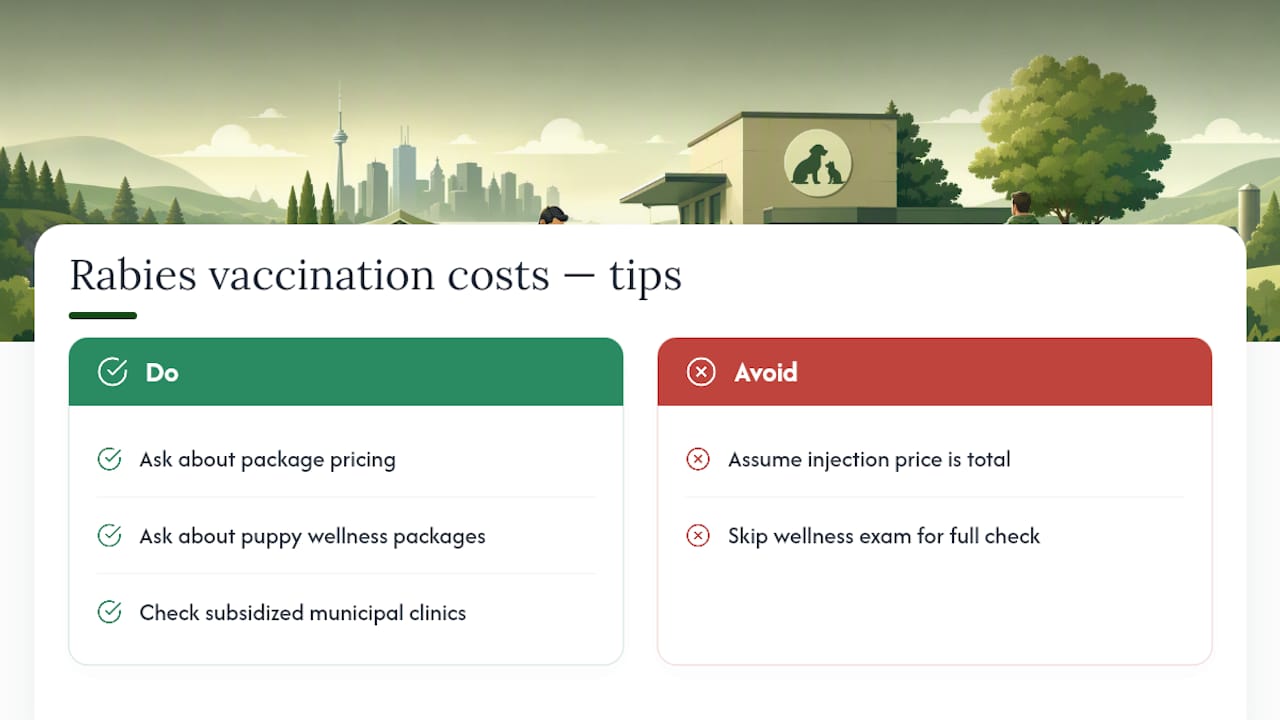
Because rabies is required by law rather than optional, some municipalities and animal welfare organizations occasionally run subsidized or low-cost clinics, especially timed around rabies awareness campaigns or shelter adoption drives. These clinics typically limit the visit to the vaccine itself, skipping the broader wellness exam, which keeps costs down but means you’re not getting the same full health check.
If cost is a concern, it’s worth asking your regular vet whether they offer any package pricing that bundles rabies with other core vaccines, since administering several vaccines during one visit usually saves you an office visit fee compared to separate appointments. New puppy owners in particular should ask about puppy wellness packages, since rabies often lines up with other early vaccinations and a first comprehensive checkup. Budgeting for that first-year visit as a slightly larger expense than routine annual boosters afterward is realistic, since puppies typically need more handling and a longer initial exam.
Booking and Preparing for the Vaccination Visit
Scheduling a rabies vaccination appointment is straightforward, but a little prep makes the visit faster and less stressful for your dog. Call the clinic directly rather than relying only on an online booking form, especially for a puppy’s first visit, since front desk staff can flag if your pup needs extra time slotted for a longer new-patient exam.
When you book, mention your dog’s age and whether this is a first vaccination or a booster. Clinics often schedule these differently since a first visit includes a more thorough intake. Ask what to bring: most clinics want any prior vaccination records, your dog’s microchip number if already chipped, and identification for yourself as the registered owner.
The morning of the appointment, keep feeding light if your dog tends toward car sickness, and bring your dog on a secure leash or in a carrier appropriate to their size. If you’re driving with a new puppy who hasn’t traveled much, a few basic precautions for the ride over go a long way toward keeping the trip calm. Arrive a few minutes early so the clinic can complete intake paperwork before the exam starts, and bring a list of any behavior or health questions you want addressed while you have the vet’s attention.
Vaccination as Part of Whole-Dog Care
At Lakewoodranchdoodles, we’ve spent over 20 years in Lindsay, Ontario, raising puppies with an eye toward lifetime health, not just the paperwork required to leave our farm. We encourage every new owner to treat that first rabies visit as more than a shot, it’s a chance to discuss nutrition, parasite prevention, and behavior with a vet who’ll know your dog for years. Our holistic approach to raising puppies carries into the advice we give new owners about their first vet visits, and we’re glad to walk you through it.
— Lakewood
Bringing Home a Puppy? Here’s How We Help You Get Started
Getting a puppy vaccinated is one piece of a much bigger picture, and if you’re still deciding where that puppy comes from, that decision shapes everything that follows, including how smooth your early vet visits go. Lakewoodranchdoodles has spent more than two decades breeding Goldendoodles, Bernedoodles, and Cockapoos in Lindsay, Ontario, with a focus on health testing, temperament, and lifetime support that doesn’t end when you drive away with your new pup.
We send every puppy home with documentation to make that first vet visit easier, prior health records, feeding guidance, and a starter kit designed to ease the transition into your household. Our holistic starter kit covers the basics new owners often scramble for in week one. If you’re weighing whether a puppy from a dedicated breeder is right for your family, browse our available puppies and reach out. We’ll walk you through what to expect at that first appointment, rabies vaccine included.
Where to Verify These Rules Yourself
For the exact legal language, read R.R.O. 1990, Reg. 567 directly. Ontario’s rabies in pets page and the OVMA’s vaccination guidance both offer plain-language summaries worth bookmarking.
Recommended
- How to Drive Safely with a Puppy on Ontario Roads – Lakewood Ranch Doodles
- Puppy Health Testing Best Practices for Canadian Buyers – Lakewood Ranch Doodles
- Best Companion Dogs for Seniors in Canada: 2026 Guide – Lakewood Ranch Doodles
- Emotional Support Animals in Canada: What You Need to Know – Lakewood Ranch Doodles