


The fastest, reliable way to leash train a Goldendoodle puppy is to start harness and collar habituation indoors at 8 weeks, use a front-clip harness with an appropriate fixed-length leash, and run short positive-reinforcement sessions where you stop the moment the leash tightens. That single rule, stop and wait for slack, does more work than any piece of equipment.
The short version before you read on:
- Fit a front-clip harness and flat collar from day one; let the puppy drag a lightweight leash indoors before you ever hold the other end
- Keep sessions short and frequent for young puppies
- Never walk forward when the leash is taut; only move when there is slack
- Delay paw-to-ground outdoor walks until vaccinations are initiated and a waiting period has elapsed; carry your puppy in arms for socialization before that window opens
- Skip retractable leashes entirely — they reinforce pulling and create safety risks
Table of Contents
- What gear do you actually need for Goldendoodle puppy leash training?
- When should you start leash training, and when is outdoor walking safe?
- How to leash train a Goldendoodle puppy: the step-by-step plan
- How do you stop a Goldendoodle puppy from pulling on the leash?
- Breeder-backed tips from Lakewoodranchdoodles
- Key Takeaways
- What success actually looks like in the first few weeks
- Lakewoodranchdoodles: built-in support for every new owner
- Useful sources
What gear do you actually need for Goldendoodle puppy leash training?
Get the equipment right before the first session. A Goldendoodle’s natural forward drive makes gear choice matter more than it does for lower-energy breeds.
The must-have list
- Front-clip harness (Y-front design preferred): A Y-front harness preserves natural shoulder rotation and redirects forward momentum back toward you when your puppy pulls. Step-in harnesses can restrict the shoulder joint if sized poorly, so check that the chest strap sits below the armpits, not across them.
What to avoid
Retractable leashes teach your puppy that pulling extends freedom, which is the exact opposite of what you want. Choke chains and prong collars have no place in puppy training. Head halters can be useful for adolescent dogs that have already learned to pull hard, but they require a careful introduction and are not a starting point for an 8-week-old.
Harness fit checklist
| Fit point | What to check |
|---|---|
| Collar | Two fingers slide under easily; not loose enough to slip over the head |
| Chest strap | Sits below the armpits, not across them |
| Back strap | Snug but not pinching; one finger clearance |
| Overall movement | Puppy walks freely; no rubbing behind the front legs |
Pro Tip: Clip your treat pouch at your left hip seam and always deliver rewards from that exact spot. Your puppy will start gravitating to that position on their own within a few sessions, which is exactly where you want them.
When should you start leash training, and when is outdoor walking safe?
These are two separate timelines, and mixing them up is one of the most common mistakes new owners make.
Start collar and harness habituation the day your puppy comes home, typically around 8 weeks. Let the puppy wear the collar for short stretches during play. Clip a lightweight leash to the harness and let it drag while you supervise. This is purely about building comfort with the equipment, not about teaching walking mechanics yet.
Outdoor paw-to-ground walks are a different matter. Unvaccinated puppies are vulnerable to parvovirus and distemper, both of which survive in soil. The safe window for low-density sidewalk walks opens after the first DHPP dose plus 7 days. High-risk environments — dog parks, pet store floors, areas with unknown dog traffic — should wait until after the 16-week vaccine series is complete.
That gap between 8 and 16 weeks is not wasted time. Carry your puppy in your arms through busy parking lots, coffee shop patios, and neighborhood streets. They are absorbing sights, sounds, and smells without touching potentially contaminated ground. You can also read more about safe socialization timing to make the most of this window.
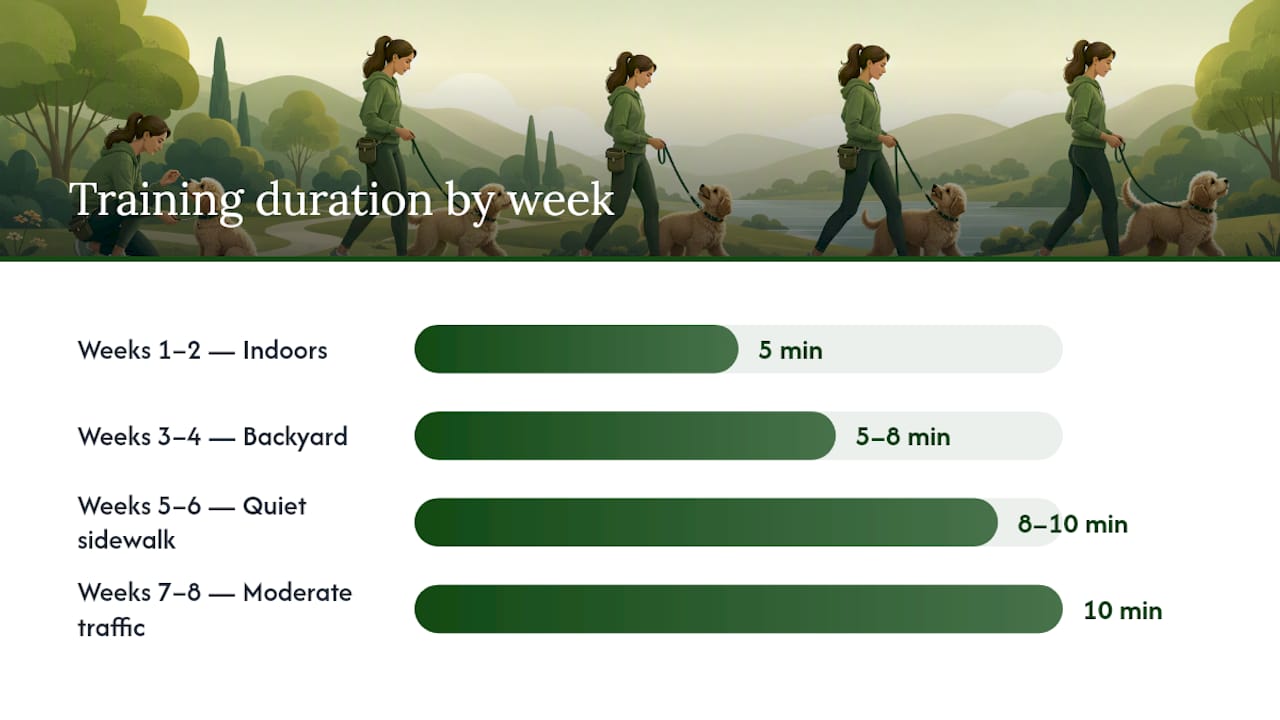
Session length for young puppies:
- Weeks 8–10: 5 minutes per session, 2–3 sessions daily, indoors only
- Weeks 10–12: 5–8 minutes, begin short backyard sessions after first DHPP + 7 days
- Weeks 12–16: 8–10 minutes, quiet sidewalks with low foot traffic
- Week 16+: Gradually expand duration, distance, and distraction level one variable at a time
How to leash train a Goldendoodle puppy: the step-by-step plan
This progression moves from equipment comfort to confident loose-leash walking over roughly 4–6 weeks with consistent daily practice. Follow the phases in order; do not skip ahead because your puppy seems ready.
Phase 1: Equipment habituation (days 1–3)
- Put the flat collar on during a play session. Reward calm acceptance with a treat.
- Introduce the harness the same way: clip it on, give treats, remove it before the puppy fusses.
- Clip a lightweight leash to the harness and let it drag for 5 minutes while you supervise. Do not hold it yet.
- Pick up the leash end and follow the puppy around the room without applying any pressure. Reward any moment the puppy glances back at you.
Phase 2: You hold the leash, short intervals (week 1–2)
- Hold the leash loosely and lure your puppy to your left side with a treat held at your hip seam.
- Take two or three steps. The moment your puppy stays at your side, mark with “yes” or a clicker and reward at the seam. Timing matters: the mark lands on the exact behavior you want, not a second later.
- If the leash tightens, stop. Stand still. Wait for the puppy to turn back and create slack, then immediately mark and move again.
- End every session before the puppy loses interest. Two good minutes beats six frustrated ones.
Phase 3: Building steps, then distance (weeks 2–6)
- Gradually increase the number of steps between rewards. Go from 3 steps to 5, then 10, then a full length of the hallway.
- Introduce the cue “with me” once the puppy is reliably checking in. Say it as they arrive at your side, not as a command to get them there.
- Move sessions from indoors to the backyard, then to a quiet sidewalk. Each new environment resets difficulty — expect more sniffing and less focus, and shorten the session accordingly.
- Practice 180-degree turns: when your puppy drifts ahead, turn and walk the other direction. Reward the moment they catch up and return to your side.
The 3 Ds: how to build duration, distraction, and distance
Progress only one variable at a time. If you add a new distraction (a busier street), shorten the duration and stay close. If you want to walk farther, do it in a quiet area first.
| Week | Duration | Distraction level | Distance |
|---|---|---|---|
| 1–2 | 5 min | Indoors, low | 10–20 ft |
| 3–4 | 5–8 min | Backyard, moderate | — |
| 5–6 | 8–10 min | Quiet sidewalk | 1–2 blocks |
| 7–8 | 10 min | Moderate foot traffic | 3–5 blocks |
How do you stop a Goldendoodle puppy from pulling on the leash?
Pulling is the most common complaint, and the fix is simpler than most owners expect. It just requires consistency that most owners underestimate.
The core technique is stop-and-wait: the moment the leash goes taut, you become a tree. No yanking, no scolding, no moving forward. Wait. Your puppy will eventually turn, step back, or sit. The instant the leash goes slack, mark it and walk forward. You are teaching that slack equals forward movement and that pulling produces nothing.
Consistency is the whole game. One family member who lets the puppy pull “just this once” can undo a week of progress. Every person who holds the leash must follow the same rule: taut leash means stopped feet.
The 180-degree turn adds a consequence beyond stopping. When your puppy surges ahead, turn and walk the opposite direction briskly. Reward when they catch up. This works especially well for dogs that are not bothered by standing still.
For persistent pullers, a front-clip harness redirects momentum back toward you physically, which makes the stop-and-wait technique easier to apply consistently. Equipment supports the method; it does not replace it.
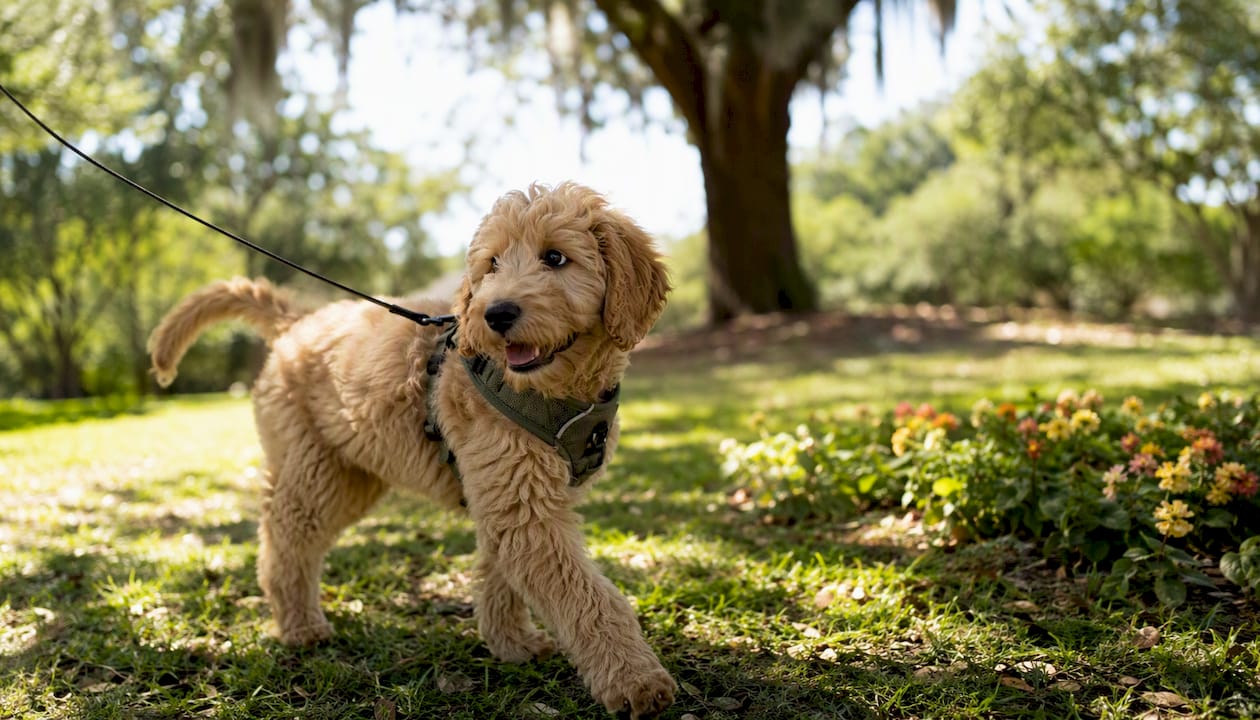
Pro Tip: For lunging at squirrels or other dogs, try “look at that”: the moment your puppy notices the trigger, say “yes” and feed a treat before they react. You are rewarding the noticing, not the lunging, and over time the trigger becomes a cue to look at you instead.
Troubleshooting other common problems
Freezing: Never drag a frozen puppy. Crouch down, make yourself small, and encourage with a happy voice. Toss a treat a foot ahead of them. Reward any movement toward you. If freezing happens consistently in a specific environment, that environment is too much too soon — back off one level of difficulty.
Leash chewing: This usually signals over-arousal or boredom. Redirect to a treat or a short play break. If it is persistent, a bite inhibition approach can help address the mouthy behavior at its root.
Over-excitement at the door: Ask for a sit before clipping the leash. If the puppy jumps up, step back inside and wait. The door only opens for four paws on the floor.
Breeder-backed tips from Lakewoodranchdoodles
After more than 20 years of raising Goldendoodles with service-animal-quality temperaments, a few things stand out about this breed specifically.
Goldendoodles are social, high-energy, and deeply motivated by their people. That combination is an asset in training — they genuinely want to be near you. The challenge is that the same enthusiasm that makes them wonderful companions also makes them pull toward everything interesting. Channel that energy rather than fight it: use play as a reward, not just treats. A quick tug session or a “go sniff” release cue at the end of a good walking stretch keeps motivation high.
Realistic timeline: most Goldendoodles show clear improvement within the first 3–5 training walks. Reliable loose-leash walking, meaning your puppy holds position through moderate distractions, typically takes 4–6 weeks of consistent daily work. Adolescence (roughly 6–18 months) often brings a regression — more pulling, more distraction, less focus. That is normal. Go back to shorter sessions and higher-value rewards, not corrections.
Use the harness only during training and walks, not all day. A puppy that wears the harness constantly stops associating it with “time to work,” which slows the conditioned response you are building.
For positive reinforcement training methods and a deeper look at command progressions, Lakewoodranchdoodles has dedicated resources that walk you through the full sequence from sit to heel.
Pro Tip: Introduce “with me” as a cue only after your puppy is already reliably checking in. Naming a behavior before it is solid just teaches the puppy to ignore the word. Wait until they are getting it right 8 out of 10 times, then add the label.
Key Takeaways
Consistent short sessions with a front-clip harness and the stop-and-wait rule are the foundation of reliable loose-leash walking for a Goldendoodle puppy within 4–6 weeks.
What success actually looks like in the first few weeks
New owners often expect a puppy to walk politely by week two. The real early win looks different: a puppy that accepts the harness without fussing, glances back at you during a walk, and takes a step or two at your side before getting distracted. That is progress. That is the foundation everything else builds on.
Leash training is not a single skill — it is a relationship your puppy is learning with you, the leash, and the world outside. Some days will feel like you went backward. That is the adolescent brain doing its job. Stay consistent, keep sessions short, and trust the process.
If you are hitting a wall at a specific behavior, Lakewoodranchdoodles offers virtual visits and lifetime support for owners. You do not have to figure it out alone.
Lakewoodranchdoodles: built-in support for every new owner
Buying a puppy from Lakewoodranchdoodles means you get more than a well-bred Goldendoodle — you get a team behind you for the life of your dog. The training resources cover everything from day-one harness introduction to advanced walking cues, written specifically for the breeds Lakewood raises. If leash training stalls, a virtual visit with the Lakewood team can pinpoint exactly what needs adjusting without a trip to a trainer’s facility.
Families considering a puppy can browse available Goldendoodle puppies and see current litters. When you are ready to take the next step, visit the available puppies page or call 705-875-5195 to book a visit, in person or virtual.
Useful sources
The citations below back the specific claims made throughout this guide. Each source is linked near the relevant section above.
- Goldendoodle pulling
- Leash training a Goldendoodle
- Teach your puppy to walk on a leash
- When to Start Training a Puppy on a Leash (the 4-Stage Timeline)
- Leash Training a Puppy: Step-by-Step Guide
- How to Train a Goldendoodle: 12-Week Plan (2026)