


Goldendoodle generations describe how many times a Poodle and Golden Retriever’s bloodline has been crossed, and that number directly predicts coat texture, shedding, and how consistent a litter turns out. An F1 puppy is a straight 50/50 split; an F1B leans roughly 75% Poodle. Multigenerational litters carry mostly Poodle genetics stacked across three or more generations for maximum consistency. Here’s the quick map:
- F1: 50% Golden Retriever, 50% Poodle. Widest trait variation, strongest hybrid vigor.
- F1B: mainly Poodle with a higher Poodle genetic influence than F1; curlier coat and generally lower shedding.
- F2: Two F1 parents bred together, still roughly 50/50.
- F2B: An F2 backcrossed to a Poodle, pushing the mix higher toward Poodle.
- Multigenerational: F3 or later, bred over generations for predictable coat and temperament.
Generation is the starting point, not the whole answer. A responsible breeder’s health testing and selection choices matter just as much as the label on the pedigree.
Key Takeaways
Goldendoodle generations describe genetic percentage and predictability, not guaranteed health or a guaranteed hypoallergenic coat.
| Point | Details |
|---|---|
| F1 means 50/50 | An F1 Goldendoodle is half Golden Retriever, half Poodle, with the widest coat variation and strongest hybrid vigor. |
| F1B favors low shedding | Backcrossing to a Poodle pushes the mix to roughly 75% Poodle, usually reducing shedding but not eliminating allergens. |
| Multigen means predictability, not a formula | F3-and-later litters are bred for consistency, but “multigenerational” describes a breeding program, not an exact percentage. |
| Health testing matters more than the label | Ask for OFA hip and elbow results, eye clearances, and genetic panels regardless of generation. |
| Lakewoodranchdoodles matches families to generations | Health-tested litters, parent visits, and lifetime breeder support help you choose beyond the generation label alone. |
Table of Contents
- What “F” and “B” Actually Mean on a Goldendoodle Pedigree
- Generation-by-Generation: What F1, F1B, F2, and Multigen Puppies Are Actually Like
- How Generation Affects Coat, Shedding, and Allergies
- Health, Hybrid Vigor, and What Testing to Ask For
- Matching a Generation to Your Household
- Why Labels Fade in Meaning After a Few Generations
- Frequently Asked Questions
- Sources
What “F” and “B” Actually Mean on a Goldendoodle Pedigree
The “F” stands for filial, meaning generation. F1 means the puppy is one generation removed from the original Golden Retriever × Poodle pairing. F2 means two F1 parents were bred together, and so on down the line. The “B” stands for backcross, which happens when a breeder takes an existing Goldendoodle and breeds it back to a purebred Poodle (almost always) rather than to another Goldendoodle. That single backcross is what shifts the percent mix from the roughly even 50/50 split of an F1 toward the Poodle-heavy 75/25 profile of an F1B, according to breed reference Goldoodle.com.
Each additional B pushes the ratio further. An F1BB, for instance, results from backcrossing an F1B again to a Poodle, which drives the Poodle percentage even higher and typically produces a tighter, curlier coat.
- F1 = 50% Golden / 50% Poodle
- F1B = mostly Poodle with some Golden Retriever (F1 backcrossed to a Poodle)
- F2 = 50% / 50% (two F1 parents)
- F1BB = higher Poodle percentage than F1B (backcrossed twice)
Pro Tip: Don’t just ask “what generation is this puppy?” Ask which two specific parents produced the litter and what generation each parent was. A breeder who can answer instantly, with pedigree paperwork in hand, is one you can trust with the rest of your questions.
Generation-by-Generation: What F1, F1B, F2, and Multigen Puppies Are Actually Like
F1 Goldendoodles are 50% Golden Retriever and 50% Poodle, and they’re the most genetically diverse generation you can buy. That genetic diversity is what breeders mean by hybrid vigor: a broader gene pool that can support robust health, though it also means littermates can look strikingly different from one another. One puppy might have a loose, wavy coat that sheds lightly; a sibling might have a straighter coat closer to a Golden Retriever’s. Shedding ranges from low to moderate. Grooming is usually manageable, brushing two or three times a week, with occasional professional trims.
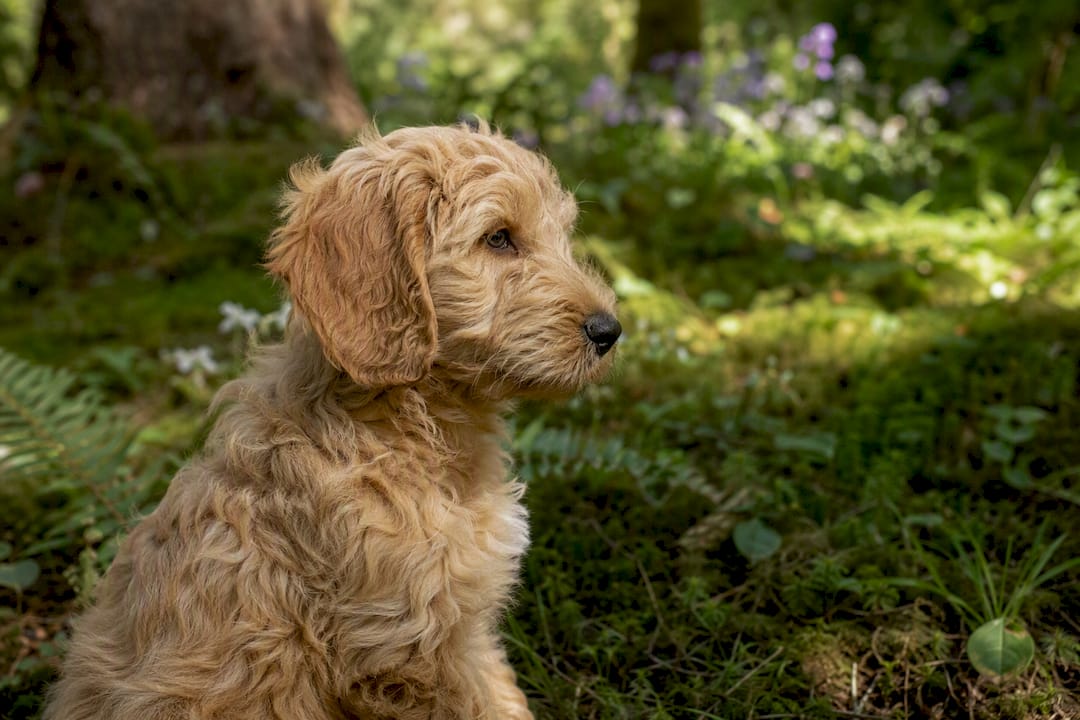
This is the generation most often recommended for allergy-sensitive households, since the added Poodle influence usually means a curlier coat and reduced shedding, per Goldoodle.com’s breed guidance. The tradeoff is grooming demand. Curlier coats mat easily and need daily brushing plus a professional groom every six to ten weeks to stay comfortable and tangle-free, a maintenance rhythm confirmed by the same source.
F2 Goldendoodles result from breeding two F1 parents together. The percentage split lands back near 50/50, but because both parents already carry Doodle genetics, F2 litters tend to show a bit more coat consistency than a first-generation cross while still landing anywhere from wavy to shaggy. Predictability improves slightly over F1, but not dramatically.
F2B Goldendoodles take an F2 and backcross it to a Poodle again, nudging the Poodle percentage higher than a straight F2 and usually producing a coat closer to F1B territory: curlier, lower shedding, higher grooming needs.
F1BB and beyond describe repeated backcrosses within the same low generation number, each one adding more Poodle genetics and typically tightening the curl pattern further.
Multigenerational (F3 and later) Goldendoodles descend from at least three generations of Doodle-to-Doodle breeding, sometimes with additional backcrosses folded in along the way. This is where breeders start selecting specifically for consistency: predictable adult size, a reliable low-shedding coat, and steady temperament across litters. According to GANA, predictability climbs the further you move from F1, but it depends entirely on the individual breeding program’s selection standards, not the generation number alone.
- Wavy, F1-type coats: brush 2 to 3 times weekly, professional groom every 8 to 12 weeks.
- Curly, Poodle-heavy coats (F1B, F2B, multigen): brush daily, professional groom every 6 to 10 weeks.
How Generation Affects Coat, Shedding, and Allergies
No Goldendoodle generation is truly hypoallergenic. More Poodle influence generally means less shedding, but allergens don’t come only from loose hair. Dander, saliva, and urine all trigger reactions too, a point Dogster makes clear when comparing F1 and F1B litters side by side.
- Straight/wavy coats (common in F1): moderate shedding, higher allergen exposure, easier grooming.
- Curly coats (common in F1B, F2B, multigen): lower shedding, somewhat reduced allergen spread, heavier grooming demand.
- Mixed litters: even within one litter, coat type can vary, so ask to see and touch the specific puppy, not just a breed description.
Myth to retire: a “non-shedding” guarantee on any Goldendoodle, regardless of generation, isn’t accurate. Lower shedding is a realistic goal; zero allergens is not.
Pro Tip: If allergies are a real concern, spend time with the puppy’s parents in person before committing. A pre-visit at the breeder’s home tells you more than any generation label ever will.
Health, Hybrid Vigor, and What Testing to Ask For
Hybrid vigor gives F1 puppies a genetic diversity edge, but that doesn’t make later generations less healthy. It makes them more predictable, provided the breeder is actively screening and selecting for health, not just coat and color.
Genetic diversity in an F1 cross can support robust health outcomes, while later generations gain predictability in coat and temperament largely through deliberate selection, not through generation number alone. Buyers should ask breeders to document their testing rather than assume either extreme.
Ask breeders directly for hip and elbow evaluations through OFA, eye clearances, and any relevant DNA panels. Resources like the UC Davis Veterinary Genetics Laboratory also offer shedding and genetic marker testing that a transparent breeder should be able to reference or provide.
- Hip and elbow OFA scores for both parents
- Eye clearance documentation
- Genetic panel results (including shedding markers where available)
- Written health guarantee terms
Matching a Generation to Your Household
Most buyers land on a generation based on one of three priorities: allergy sensitivity, grooming tolerance, or wanting a classic retriever look. Mild allergy households often do best with an F1B or later backcross; families who want the loose, familiar Golden coat and don’t mind moderate shedding often prefer an F1.
- Identify your top priority (allergies, low grooming effort, or classic Golden appearance).
- Match that priority to a generation: F1B/multigen for allergies, F1 for looser coats and lower grooming, multigen for predictable adult size and temperament.
- Confirm the match with the breeder’s actual health test results and a look at the specific litter, not just the generation label.
Before placing a deposit, ask about health testing documentation, how puppies are socialized before going home, and what support or return policy the breeder offers after the sale.
Why Labels Fade in Meaning After a Few Generations
Filial labels are genuinely useful for F1 and F1B litters, since the math behind the percent mix is straightforward. Past that point, “multigenerational” becomes more of a program description than a precise formula.
Generation labels provide clear context for early crosses, but that context weakens considerably in later generations. Breeders should describe the physical traits buyers can expect directly, rather than relying on the label to do that work.
That’s the guidance GANA gives breeders, and it’s worth holding your own breeder to the same standard.
- Photos of both parents at full adult coat, not just as puppies
- Copies of actual health clearance documents, not verbal assurances
- Written notes on temperament and coat texture specific to that litter
A breeder’s take on generations, temperament, and matching families
Over 20-plus years of raising service-animal-quality temperaments, we’ve learned that generation is a starting conversation, not the finish line. For a family managing allergies, we lean toward F1B or later litters and back that recommendation with parent visits and coat samples. For an active family that wants a classic Golden look and doesn’t mind a bit more shedding, an F1 often fits better. Either way, health testing comes first.
How Lakewoodranchdoodles Helps You Pick the Right Generation
Reading about percentages and coat types only gets you so far. What actually settles the decision is meeting the parents, reviewing real health clearances, and asking pointed questions about a specific litter, not a generic label. Lakewoodranchdoodles gives you all three: documented health testing on every breeding dog, parent photos and visits by appointment (in person or virtual), and lifetime breeder support that continues well past pickup day.
If you’ve settled on F1 for that classic Golden look, or F1B for lighter shedding around allergy-sensitive family members, browse our current Goldendoodle puppies or the full list of available puppies to see what’s ready now. Call 705 875 5195 to schedule a visit, or request a virtual walkthrough of a litter before you decide.
Frequently Asked Questions
What’s the real difference between F1 and F1B Goldendoodles?
What does F1BB mean on a Goldendoodle pedigree? F1BB means an F1B was backcrossed to a Poodle again, pushing the Poodle percentage even higher than a standard F1B and typically producing a tighter, lower-shedding coat.
What’s the difference between F1 and F2 Goldendoodles? An F2 comes from breeding two F1 parents together, landing around 50/50 like an F1, but often showing slightly more coat consistency since both parents already carry Doodle genetics.
What does multigenerational actually mean? Multigenerational generally means F3 or later, bred over several generations specifically for predictable coat, size, and temperament, though the exact definition varies by breeding program.
Is any Goldendoodle generation truly hypoallergenic? No. Higher-Poodle generations like F1B typically shed less, but allergens also come from dander and saliva, so allergy risk is reduced, not eliminated.
Which generation is best for a first-time owner? Many first-time owners do well with an F1 or F1B, depending on grooming tolerance and allergy sensitivity, provided the breeder has documented health testing and can describe the specific litter’s expected traits.
Sources
- Goldoodle
- Goldendoodle generations — Goldendoodle Association of North America (GANA)
- Shedding test resources — UC Davis Veterinary Genetics Laboratory
- Orthopedic Foundation for Animals (OFA)
- F1 vs F1B Goldendoodle: Generation Differences Explained — Dogster