


A Goldendoodle’s adult coat settles into one of three main textures: straight, wavy, or curly. That outcome comes down to a small set of genes, primarily KRT71, FGF5, and RSPO2, not the F1 or F1B label stamped on a litter announcement. Straight coats shed the most and need the least brushing. Wavy coats sit in the middle on both counts. Curly coats shed the least but demand the most grooming time and the highest mat vigilance.
Here’s the quick breakdown before we get into the genetics and the grooming schedules:
- Straight (flat) coat: Looks close to a Golden Retriever’s coat, sheds noticeably, lowest daily maintenance.
- Wavy (fleece) coat: Loose S-shaped waves, the most common outcome in Goldendoodles, moderate shedding and brushing needs.
- Curly (wool) coat: Tight, springy curls, minimal shedding, but the highest risk of matting without consistent care.
Three genes drive nearly all of this. KRT71 governs curl. FGF5 controls hair length. RSPO2 determines whether a dog grows the beard and eyebrows people associate with the “doodle” look, or lacks them entirely. Lakewoodranchdoodles works these genetic markers into its breeding decisions specifically because they predict grooming reality far better than a generation code ever could.
Key Takeaways
Goldendoodle coat type comes down to a small set of genes and a predictable maintenance curve, not luck or generation labels alone.
| Point | Details |
|---|---|
| Three coat types exist | Straight, wavy, and curly, driven mainly by KRT71, FGF5, and RSPO2 genetics. |
| Wavy is most common | It offers a moderate shed rate and moderate brushing needs compared with straight or curly. |
| Coat blow is the riskiest window | Occurring roughly between 6 and 14 months, it demands daily brushing and pro grooming every 4 to 6 weeks. |
| DNA testing beats guessing | KRT71, FGF5, and RSPO2 panels predict texture and furnishings far better than F1 or F1B labels. |
| Start grooming early | Introducing brushing and pro visits by 5 months reduces stress and mat risk during the coat transition. |
If you’re still deciding which coat type fits your household, browsing available Goldendoodle puppies is a good next step, and our team can walk you through parent coat photos and testing results before you commit.
Where This Guide’s Information Comes From
- The Goldendoodle Association of North America is the strongest source for the underlying genetics: KRT71, FGF5, and RSPO2.
- Goldendoodle Report’s coat types guide is best for generation-to-texture probability and grooming cadence detail.
- Goldendoodle Report’s coat blowing guide covers the puppy-to-adult transition timeline and mat-prevention tactics in depth.
- Goldoodle’s basics page is a solid overview for understanding why puppy coats aren’t predictive on their own.
- Poodle Report offers useful detail on shedding and allergy considerations across coat types.
| Source | Best Used For |
|---|---|
| Goldendoodle Association of North America | Genetics: KRT71, FGF5, RSPO2 |
| Goldendoodle Report (coat types) | Generation probability and grooming cadence |
| Goldendoodle Report (coat blowing) | Transition timeline and mat prevention |
| Goldoodle basics | Puppy coat unpredictability |
| Poodle Report | Shedding and allergy considerations |
Table of Contents
- What Determines Goldendoodle Coat Types Genetically?
- What Do the Different Coat Textures Look Like?
- When Does a Goldendoodle’s Coat Change From Puppy to Adult?
- How Should You Groom Each Goldendoodle Coat Type?
- How Do You Predict a Puppy’s Adult Coat Before It Grows In?
- What Should You Do From Puppy Pickup Through the First Year?
- A Breeder’s View on Goldendoodle Coats
- Frequently Asked Questions
- Sources
What Determines Goldendoodle Coat Types Genetically?
Coat outcome isn’t a coin flip. It’s the product of three specific genes interacting, and once you understand what each one does, a litter of puppies stops looking random and starts looking predictable.
KRT71 is the curl gene. It comes in variant pairs, and the combination a puppy inherits maps fairly reliably to texture. Dogs with two curl alleles (+/+) tend toward curly coats. One curl allele paired with one straight allele (+/-) tends to produce wavy coats. Two straight alleles (-/-) usually means a straight coat. The Goldendoodle Association of North America uses this exact framework to explain why litters from the same parents can still produce a mix of textures.
FGF5 controls hair length. It doesn’t decide curl or texture on its own, but it changes how pronounced that texture reads visually. A longer coat with a low curl expression can look wavier than it genetically is, just because there’s more hair to catch light and fall into loose shapes.
RSPO2 is the furnishings gene, and it’s the one people underestimate most. It’s responsible for the beard, the bushy eyebrows, and the general “teddy bear” face that makes a Goldendoodle look like a Goldendoodle instead of a shedding Golden Retriever with a perm. Dogs that lack the furnishings gene end up with what breeders call an improper or non-mixed coat: a flatter face, thinner overall coat, and a shed pattern closer to the retriever side of the pedigree.
Put those three genes together and you get the four visual outcomes most owners actually encounter: curly, wavy, straight with furnishings, and improper/flat without them.
- KRT71 sets the curl baseline (curly, wavy, or straight).
- FGF5 stretches or shortens how that curl reads visually.
- RSPO2 adds or removes the beard, eyebrows, and mustache.
- The four combinations explain nearly every coat a Goldendoodle owner will ever see.
Pro Tip: Before you commit to a puppy, ask the breeder for DNA test results on KRT71, FGF5, and RSPO2. A reputable program tests for these markers specifically because generation labels like F1 or F1B only shift probabilities, and a real lab panel tells you far more than a pedigree chart ever will.
What Do the Different Coat Textures Look Like?
Recognizing a coat type by sight takes some practice, especially on a young puppy, but the differences become obvious once you know what to look for.
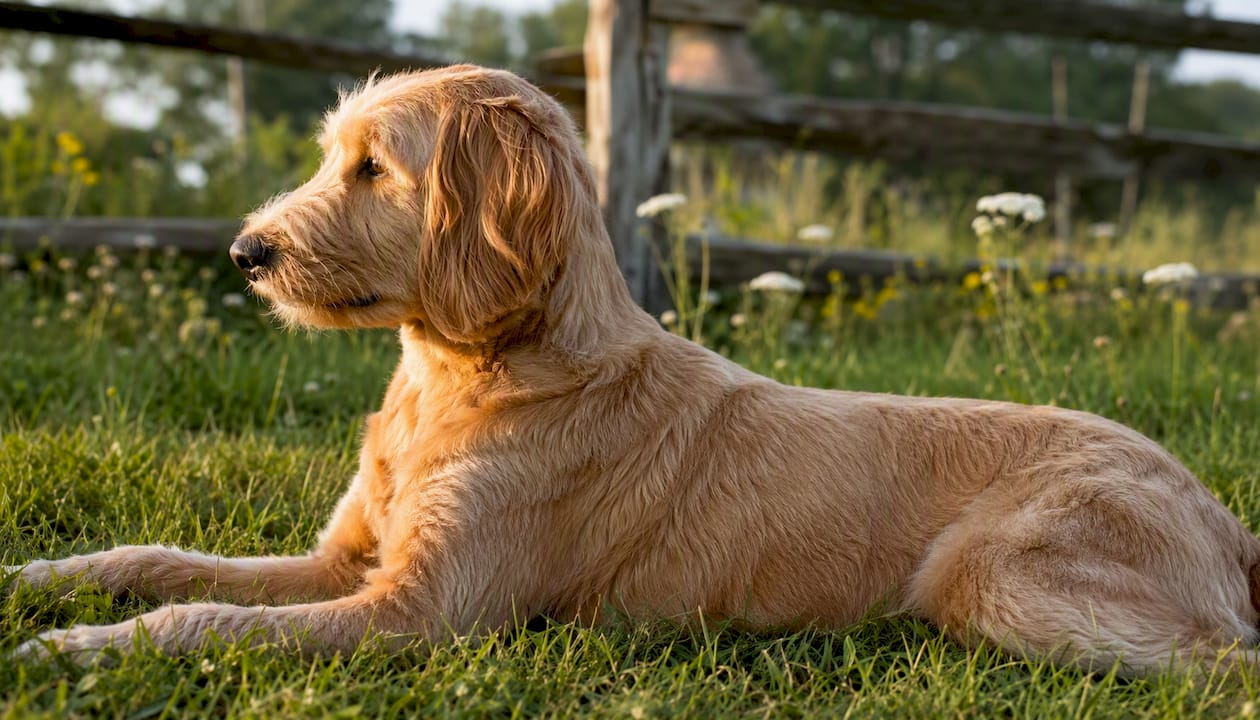
Straight or flat coat
A straight coat lies close to the body with little to no wave. It often resembles the Golden Retriever parent more than the Poodle side, and it’s usually the coat you’ll see on a dog that inherited two straight KRT71 alleles or lacks furnishings entirely. Shedding is noticeably higher than the other two types, and facial furnishings are often minimal or absent. This coat suits owners who want a doodle’s temperament without heavy grooming demands, and it’s a reasonable fit for households that don’t have allergy concerns driving the decision.
Wavy or fleece coat
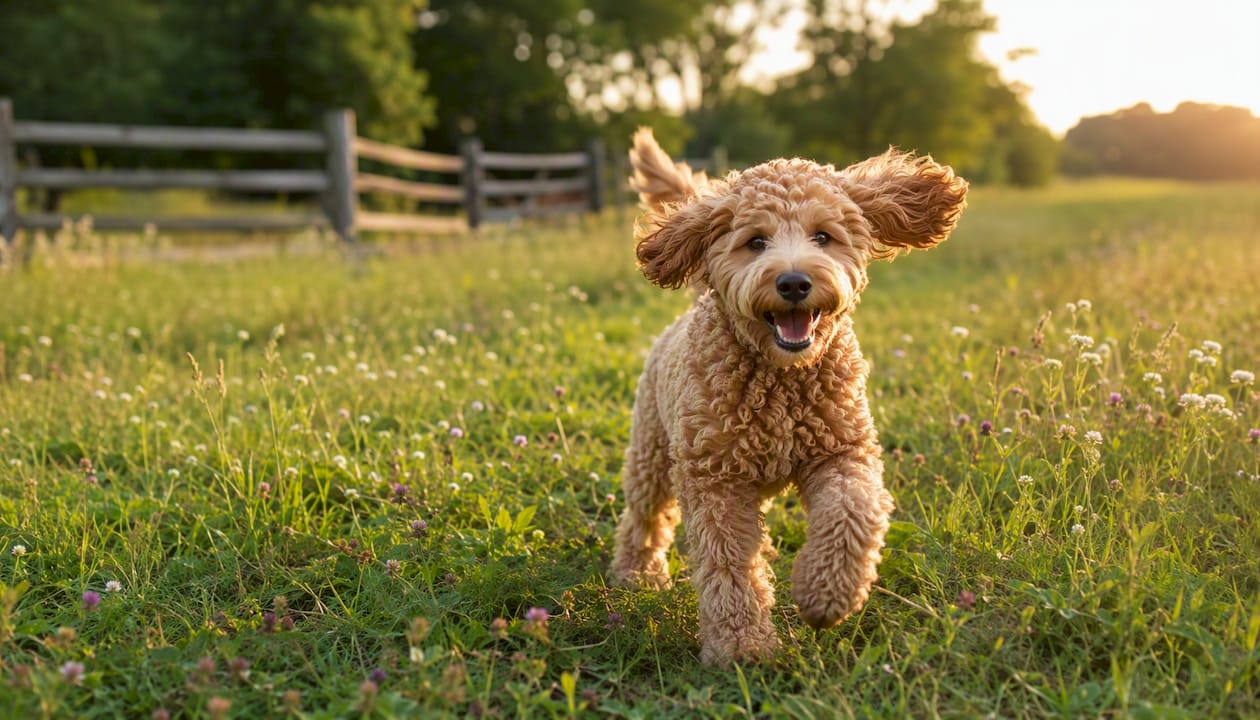
Wavy is the most common outcome in Goldendoodle litters, and there’s a good reason it shows up so often: it’s the natural middle ground of the KRT71 spectrum. The hair forms loose, open S-shaped waves rather than tight springs, giving that soft, tousled “teddy bear” look most people picture when they hear the word Goldendoodle. Shedding is moderate, brushing needs are moderate, and most owners find it the easiest texture to live with long term.
Curly or wool coat
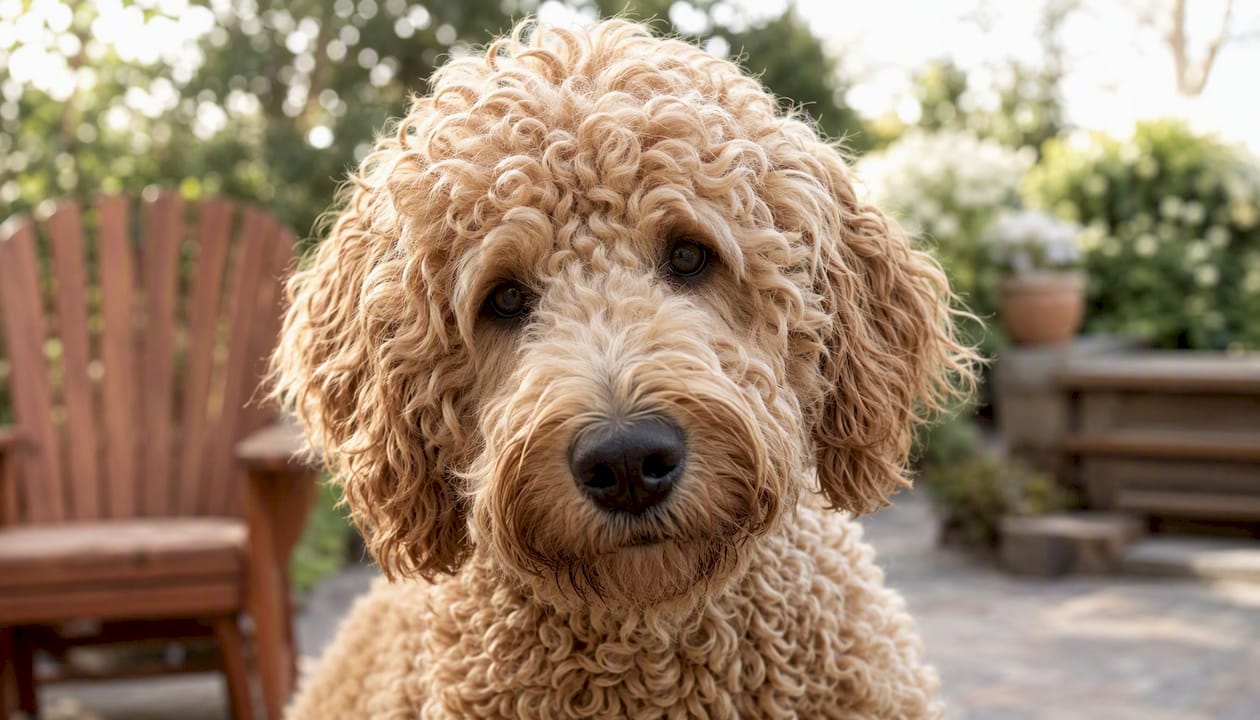
Curly coats form tight, springy ringlets that closely resemble a Poodle’s coat. This texture sheds the least of the three, which is why it’s the texture most often recommended for people managing dog allergies. But that low shed rate comes at a cost: loose hair doesn’t fall to the floor, it gets trapped in the curl and mats fast if brushing lapses. Curly coats need the most consistent grooming schedule of any Goldendoodle coat type.
The improper or flat coat variant
This one confuses a lot of new owners because it sounds like a synonym for “straight,” and it isn’t quite. An improper (or non-mixed) coat happens when a puppy lacks the RSPO2 furnishings gene altogether, not just when it has straight-leaning KRT71 alleles. The result is a thinner coat, no beard or eyebrows, and a shed pattern that mirrors a Golden Retriever’s seasonal blow far more than a Poodle’s does.
Pro Tip: If you’re comparing photos online to guess your puppy’s future coat, look at labeled galleries side by side rather than single stock images. Lighting and grooming style change how a coat photographs far more than most people expect, and a freshly-groomed curly coat can look deceptively straight right after a blowout.
When Does a Goldendoodle’s Coat Change From Puppy to Adult?
This is the part most first-time owners aren’t ready for. Somewhere between roughly 6 and 14 months old, Goldendoodle puppies “blow” their puppy coat, shedding the soft undercoat they were born with and growing in their true adult texture underneath it. The process typically runs 8 to 16 weeks from start to finish, though timing varies by dog.
Here’s why this period matters so much: for a few weeks, your dog is wearing two coats at once. The dying puppy fluff is still tangled through the new adult hair growing in beneath it, and that overlap is exactly what creates mats. A coat that looked perfectly manageable at four months can turn into a solid felted mess by month eight if brushing lapses even for a week or two.
- Watch for the signs. Dullness, patchy texture, and sudden clumping around the ears, armpits, and tail base usually signal the blow has started.
- Switch to daily line-brushing. Brushing in sections down to the skin, not just skimming the top coat, is the only way to catch tangles before they compact.
- Book professional grooming every 4 to 6 weeks during the transition. A groomer with clippers and the right tools can catch mats you’d miss at home, especially behind the ears and in the “armpit” area.
- Expect a shorter trim than usual. Groomers often take more length off during coat blow specifically to remove trapped undercoat and prevent it from felting against the skin.
- Resume normal cadence once the adult coat settles, typically by 12 to 18 months, when the true texture is fully in.
- Use a metal comb after brushing to check for hidden mats near the skin, not just the surface.
- A detangler spray can loosen minor knots before they compound, but it’s not a substitute for a slicker brush.
- If a mat is tight against the skin and won’t comb out, stop and call a groomer instead of forcing it.
Pro Tip: Start professional grooming visits before your puppy turns 5 months old, even if there’s barely anything to trim yet. Getting a young dog used to the dryer noise, the table, and a stranger’s hands before coat blow hits makes the high-maintenance months dramatically less stressful for everyone involved, dog included.
How Should You Groom Each Goldendoodle Coat Type?
Long-term maintenance looks different depending on which texture your dog ended up with, and matching your routine to the actual coat, not the coat you wish you had, saves you both time and money.
Curly coats need a slicker brush and metal comb daily. Skipping even two or three days lets loose hair felt into the curl, and once a mat sets against the skin, cutting it out is often the only fix. Bathing curly coats requires patience on the back end. These coats hold moisture, and drying them incompletely with a towel alone can trap dampness against the skin and lead to a musty or mildew-like smell and occasional hot spots. A high-velocity dryer, used correctly, solves this.
Wavy coats do well with a slicker brush three to four times a week, plus a comb pass to check for tangles behind the ears and under the collar, the two spots where mats form first regardless of coat type. Professional grooming every 6 to 8 weeks keeps a wavy coat looking clean without the daily time investment curly coats demand.
Straight coats are the easiest by a wide margin. A pin brush or slicker one to two times a week handles most of the loose hair, and professional visits every 8 to 12 weeks are usually enough. The tradeoff is shedding: straight-coated Goldendoodles will leave more hair on furniture and clothing than their wavy or curly littermates.
Grooming interval guidance from breeder and grooming resources consistently lands in these ranges, with the caveat that all three intervals should shorten to every 4 to 6 weeks during the coat blow period regardless of adult texture. A broader coat maintenance reference can help you build tools and habits around whichever schedule fits your dog.
Trapped debris under a curly or heavily furnished coat is one of the most overlooked problems owners run into. Grass seeds, burrs, and dirt work down into the undercoat and stay there, which is part of why regular brushing matters even for dogs who aren’t showing visible mats yet.
How Do You Predict a Puppy’s Adult Coat Before It Grows In?
Generation labels get treated like guarantees, and they aren’t. An F1B Goldendoodle (roughly 75% Poodle) is statistically more likely to land curly, and an F1 (an even split) more often produces a wavy coat, but “more likely” is doing a lot of work in that sentence. F2 litters and beyond widen the range further, since both parents are already mixed breeds carrying a blend of alleles.
The F1 versus F1B comparison is worth reading in full if you’re weighing which generation to look for, but the honest takeaway is that generation shifts odds, not outcomes.
What actually tells you more, before a coat fully develops, is the puppy in front of you. The muzzle is one of the earliest reliable indicators of adult curl expression. Curl often shows up around the face and whiskers weeks before it appears anywhere else on the body. Ear hair texture is another early tell, and so is how much loose hair a puppy sheds onto a dark shirt after being held for a few minutes.
- Check the muzzle first. Wiry or curling whisker hair usually points toward a curlier adult coat.
- Feel the ear hair. Softer, wavier ear fuzz tends to mirror the eventual body coat.
- Note the shed pattern. A puppy leaving visible hair on clothing at eight weeks is trending toward the straighter end of the spectrum.
- Ask for DNA test results. KRT71, FGF5, and RSPO2 panels remove the guesswork entirely when a breeder has them on file.
Pro Tip: Request DNA reports for both parents and ask to see current photos of them, not just puppy photos from years ago. Coats change with age and grooming style, so a recent, unstyled photo tells you more than an old show-cut photo ever will. Browsing available Goldendoodle males and Goldendoodle females side by side is a useful way to compare parent phenotypes before you commit to a litter.
What Should You Do From Puppy Pickup Through the First Year?
A puppy’s soft newborn coat tells you almost nothing about what’s coming. Most puppies carry a fluffy, undifferentiated coat that shifts gradually until it settles into its true adult form between 12 and 18 months. Everything in between is a management window, and the timeline below reflects what breeders and groomers generally recommend.
At pickup (8 to 10 weeks): begin light, low-pressure brushing sessions, even before there’s much to brush. The goal is exposure, not results. Handle paws, ears, and the muzzle regularly so nothing about grooming feels new later.
By 2 to 4 months: establish a home brushing rhythm two to three times a week and introduce bath time with a proper puppy shampoo and a full dry.
By 5 months: schedule the first professional grooming visit, even if it’s just a bath, brush-out, and sanitary trim. This is the desensitization window professional groomers point to most often, and starting before coat blow hits reduces the odds of an emergency shave-down later.
From 6 to 14 months, during the coat blow: shift to daily line-brushing and book professional appointments every 4 to 6 weeks regardless of what texture the dog is trending toward.
By 12 to 18 months: the adult coat is typically settled, and you can return to the standard maintenance schedule that matches whichever texture your dog landed on.
Keep a simple record as you go: dated photos every few weeks, notes on when mats showed up and where, and any DNA results you were given at pickup. That record is genuinely useful to hand off to a new groomer, and it’s the kind of documentation Lakewoodranchdoodles encourages every new owner to start on day one, not scramble to reconstruct at month nine.
When you’re evaluating a breeder, ask directly about their DNA testing practices and what their breeding goals are for coat and temperament. A program that can show you KRT71, FGF5, and RSPO2 results for its breeding dogs is telling you something concrete about how seriously it takes predictability, not just marketing language about “guaranteed hypoallergenic puppies.”
Pro Tip: Ask a prospective breeder how they select breeding pairs for coat outcomes specifically. A vague answer about “years of experience” isn’t the same as a program that tests and tracks genetic markers litter over litter.
A Breeder’s View on Goldendoodle Coats
Over 20 years of raising doodles, the single most common surprise we hear from new owners isn’t about coat color or size. It’s the coat blow. Families plan for a cute, low-shed puppy and then get blindsided around month eight when that same coat starts matting overnight, and they assume something went wrong. Nothing went wrong. It’s biology doing exactly what it’s supposed to do, just on a timeline nobody warned them about.
If there’s one thing I’d tell every new owner to prioritize in the first months, it’s this: start the brushing and grooming routine before you think you need it. Don’t wait for the first mat to show up as your cue to buy a slicker brush. Desensitize early, book that first professional visit around five months, and treat the coat blow window as a scheduled event you’re preparing for, not a crisis you’re reacting to. Owners who do this sail through the transition. Owners who don’t often end up with a shave-down they didn’t want, on a dog that’s now afraid of the grooming table.
Lifetime breeder support means we’re still answering these questions long after pickup day, and coat questions are the ones we field most, year after year.
Frequently Asked Questions
What are the three main Goldendoodle coat types? Straight, wavy, and curly. Wavy is the most common, and each type maps to a different shedding level and grooming schedule, with straight shedding most and curly shedding least.
How can I tell what coat type my Goldendoodle puppy will have? Check the muzzle and whisker area first, since curl often shows there before anywhere else on the body. Ear hair texture and how much loose hair a puppy sheds onto clothing are also early clues, though nothing is certain until the adult coat settles between 12 and 18 months.
Are curly Goldendoodles hypoallergenic? No dog is completely hypoallergenic. Curly coats trap loose hair rather than shedding it, which reduces airborne allergens compared to straight coats, but people react to dander and saliva proteins, not just hair itself.
When does a Goldendoodle’s puppy coat change to an adult coat? Most puppies go through coat blow between roughly 6 and 14 months, with the transition lasting 8 to 16 weeks. Daily brushing and professional grooming every 4 to 6 weeks during this window prevent severe matting.
Do F1 and F1B Goldendoodles have different coat types? Generation affects probability, not certainty.
How often should I brush my Goldendoodle based on coat type? Curly coats need daily brushing, wavy coats need three to four sessions a week, and straight coats generally do fine with one to two sessions weekly.
## Sources
- [Goldendoodle Appearance - Goldendoodle Association of North America](https://www.goldendoodleassociation.com/about-the-breed/coat-types-and-colors/)
- [Goldendoodle Coat Types Explained COMPLETE GUIDE | 2026](https://goldendoodlereport.com/goldendoodle-coat-types-explained/)
- [Goldendoodle Coat Blowing Guide TRANSITION + MATS | 2026](https://goldendoodlereport.com/goldendoodle-coat-blowing-guide/)
- [Goldendoodle Coat Types: Straight, Wavy & Curly Guide](https://goldoodle.com/basics/coats)
- [Goldendoodle hair types, attributes, coat color and care | Poodle Report](https://poodlereport.com/goldendoodle-hair-types-attributes-coat-color-and-care/)

## Recommended

- [Goldendoodle Allergy Friendly Home Tips for Canadians – Lakewood Ranch Doodles](https://lakewoodranchdoodles.com/blogs/about-us-and-our-breeding-program/goldendoodle-allergy-friendly-home-tips-for-canadians)
- [Dog Coat Maintenance Guide: All 5 Types Explained – Lakewood Ranch Doodles](https://lakewoodranchdoodles.com/blogs/about-us-and-our-breeding-program/types-of-dog-coat-maintenance)
- [Goldendoodle Males – Lakewood Ranch Doodles](https://lakewoodranchdoodles.com/pages/copy-of-goldendoodle-males)
- [Goldendoodle Puppies – Lakewood Ranch Doodles](https://lakewoodranchdoodles.com/pages/goldendoodle-puppies)