


Ethical dog breeding means health-first selection, genetic screening, welfare of the breeding dogs, and lifetime responsibility for every puppy produced. Two reference points worth knowing, without endorsing either as the sole authority, are the ASPCA and the AKC. A legitimate breeder gives you health documentation, a chance to visit, and a written contract that outlines support long after the sale.
TL;DR:
- Ethical breeders conduct comprehensive health screenings and genetic testing, including DNA panels and Estimated Breeding Values, to minimize hereditary health issues.
- They carefully avoid inbreeding by using calculation tools and limit sire contributions to preserve genetic diversity and reduce disease risks.
- Responsible breeding prioritizes maternal welfare with age limits, recovery time, and temperament screening, avoiding routine surgeries or breeding insecure females.
- Buyers should verify breeder claims through thorough in-person visits, document checks, and veterinarian consultations, rather than relying solely on paperwork or reputation.
- The most critical indicator of ethical breeding is a clear, written take-back policy, ensuring lifetime responsibility for each dog regardless of circumstances.
Table of Contents
- What Makes Dog Breeding Ethical or Irresponsible?
- What Do Ethical Breeders Actually Do Differently?
- How Do You Verify a Breeder Is Actually Ethical?
- What Are the Warning Signs of Unethical Breeding?
- Your Step-by-Step Checklist for Finding an Ethical Breeder
- How Lakewoodranchdoodles Approaches Ethical Breeding in Practice
- Where Most Buyers Get This Wrong
- Ready to Bring Home a Puppy Bred the Right Way?
- Sources
What Makes Dog Breeding Ethical or Irresponsible?
Ethical breeding is not just “breeding with good intentions.” It’s a set of practices that puts a dog’s physical health, temperament, and welfare ahead of profit, appearance, or convenience. The ASPCA’s position statement on responsible breeding frames it as a lifetime commitment: breeders should be prepared to take back any dog they produced, at any point in that dog’s life, no matter the reason.
That commitment is the dividing line between a breeder and a seller. Anyone can advertise puppies. Far fewer are willing to answer the phone five years later when a dog’s owner has lost a job, moved into a building that won’t allow pets, or is struggling with behavior problems they didn’t expect.
Responsible breeding also has a limit. When a breed’s population is already oversaturated in shelters and rescues, or when a specific pairing carries known genetic risk, the ethical choice is not to breed at all. The AKC’s guide to responsible dog breeding frames good breeders as people who “breed to improve” the dog, not simply to reproduce it. That mindset assumes restraint is part of the job.
Four values show up consistently across the major standards:
- Welfare first. Breeding dogs live as family members, not production units, with real veterinary care and rest between litters.
- Genetic health. Sires and dams are screened for known hereditary conditions before any pairing is planned.
- Temperament. Stable, confident dogs are chosen over dogs with anxiety or aggression issues, regardless of how they look on paper.
- Stewardship. The breeder sees the breed’s long-term health and diversity as their responsibility, not just the health of one litter.
Guidance adapted from RSPCA Australia and published through the EU animal welfare platform adds a practical layer: avoid exaggerated physical traits, track inbreeding mathematically rather than by guesswork, and use validated genetic tests instead of relying on a clean-looking pedigree alone. That last point matters more than most buyers realize. A pedigree tells you who a dog’s ancestors were. It does not tell you whether those ancestors, or the dog in front of you, carry recessive genes for hip dysplasia, eye disease, or heart conditions.
What Do Ethical Breeders Actually Do Differently?
Anyone can claim to be a responsible breeder. The differences show up in specific, checkable practices, not in marketing language.
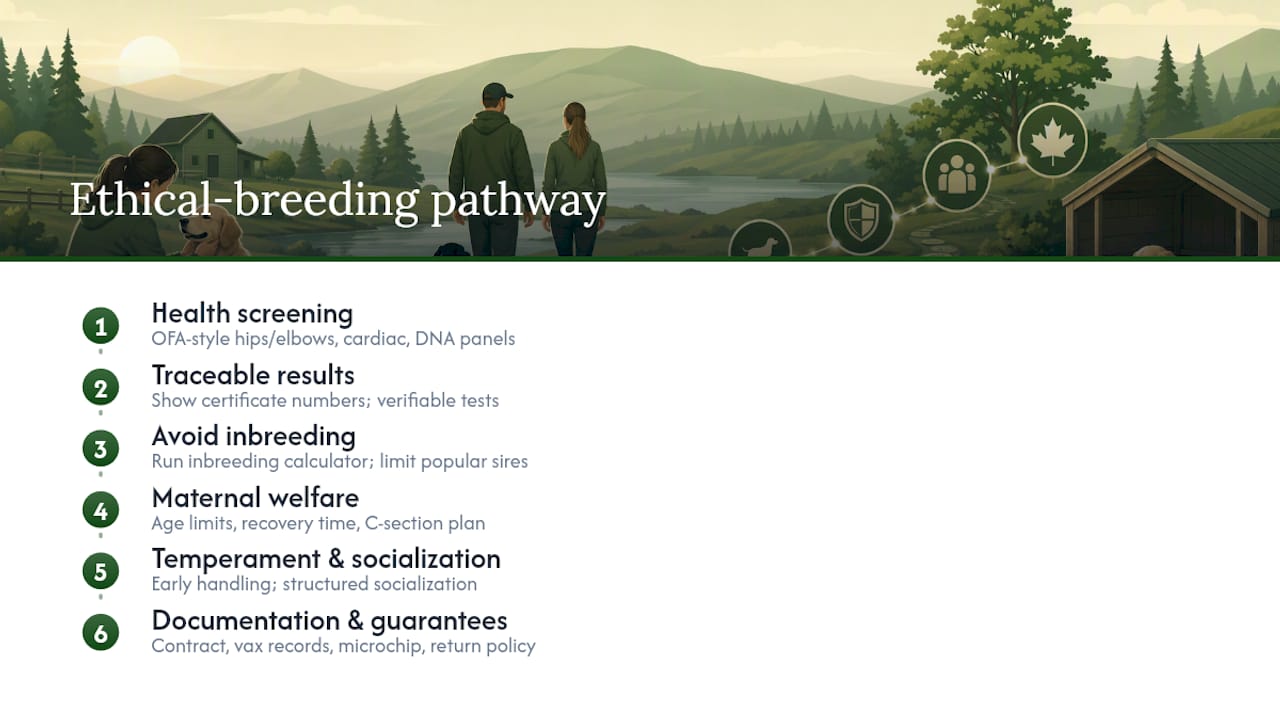
Health screening and genetic testing. Before a pairing happens, both dogs go through breed-appropriate testing, things like hip and elbow evaluations, eye certifications, cardiac clearances, and DNA panels for known hereditary diseases. A breeder following AKC guidance will show you the actual results, not just tell you the dogs “passed.” Ask to see the certificate numbers. Legitimate results are traceable through the testing organization.
Genetic panels alone don’t catch everything, though. Many health traits, like hip conformation or certain cancers, are polygenic, meaning dozens of genes interact to produce the outcome. That’s why some breeders now factor in Estimated Breeding Values, a statistical tool that predicts how likely a dog is to pass on a trait based on the health outcomes of its relatives, not just its own test results.
Avoiding inbreeding. High inbreeding coefficients raise the risk of hereditary disease and reduced fertility, a link the ASPCA draws directly. The Royal Kennel Club recommends breeders run pairings through an inbreeding calculator before committing to a litter, rather than relying on instinct. Practical guidance also warns against the popular-sire effect: when one male fathers a large share of litters in a breed population, he narrows the genetic pool for generations. A widely cited threshold caps any single sire’s contribution to a small share of puppies born in a defined period.
Maternal welfare. A dam’s wellbeing should shape the breeding schedule, not the other way around. That means age limits before a first litter, adequate recovery time between pregnancies, and a clear plan if a C-section becomes necessary rather than routine. Breeders following AKC guidance won’t breed a female with an unstable or insecure temperament even if her pedigree and structure are excellent, because temperament traits pass down just as reliably as coat color.
Temperament and early handling. Puppies raised with structured socialization during development tend to adjust faster to new homes and show fewer behavior problems later. This is where handling in the first weeks of life makes a measurable difference, not something that can be fixed entirely after a puppy leaves the litter.
Documentation and transparency. A written contract with health guarantees, a return policy, vaccination and parasite treatment records, microchip registration, and a full pedigree should all be handed over without you having to ask twice.
Statistic to remember: hip and elbow certification through OFA-style screening, cardiac clearance, and breed-specific DNA panels form the baseline the AKC recommends before any mating is planned, not after a litter is already on the ground.
Lifetime responsibility ties it all together. A breeder who commits, in writing, to taking a dog back at any age for any reason is telling you something concrete about how they view the dogs they produce.
How Do You Verify a Breeder Is Actually Ethical?
Claims are easy. Verification takes a few direct steps, and it’s worth doing all of them before any money changes hands.
- Ask pointed questions before you visit. What health tests were done on both parents, and can you see the results? Will you meet a veterinarian who works with this breeder? What happens if the dog develops a health problem at two years old, or ten?
- Visit in person if at all possible. Notice whether the space is clean, whether puppies are underfoot with people rather than isolated in a back room, and whether you can meet at least one parent. A dam who is relaxed around visitors tells you more about temperament than any brochure.
- Request the paperwork and actually check it. Genetic test reports, vaccination records, a microchip number you can look up, and a pedigree are the minimum. If the breed has a known C-section tendency, ask about the dam’s whelping history directly.
- Watch how puppies are handled. Are they being touched, exposed to different surfaces and sounds, and given a moment to explore on their own? Or are they kept in a kennel until a buyer arrives?
- Loop in a veterinarian before final payment. An independent pre-purchase exam, or even a phone consultation with your own vet about the breeder’s provided test results, catches things a casual look won’t. A resource like the PAW Vet Practice referral network is a reasonable way to find someone who can do this kind of check.
Documents worth requesting, specifically:
- Genetic test certificates with ID numbers you can verify independently
- Full vaccination and deworming schedule to date
- Registered pedigree, ideally three or more generations
- Any C-section or whelping complication history for the dam
- Microchip registration paperwork showing the puppy is chipped before pickup
Watch for these red flags, and treat any one of them as a reason to walk away:
- The breeder sells through a broker, classifieds site, or pet store rather than directly.
- Multiple litters are available at once, or litters seem to arrive on a constant rotation.
- You’re told visits “aren’t possible” or records “aren’t ready yet.”
- There’s pressure to pay a deposit or the full price before you’ve seen any documentation.
- The price is unusually low for the breed, with no health guarantee attached.
The Animal Humane Society specifically flags commercial-scale operations, brokers, and pet-store pipelines as the setups most likely to hide poor breeding conditions. That’s not a coincidence. Volume and transparency tend to move in opposite directions.
What Are the Warning Signs of Unethical Breeding?
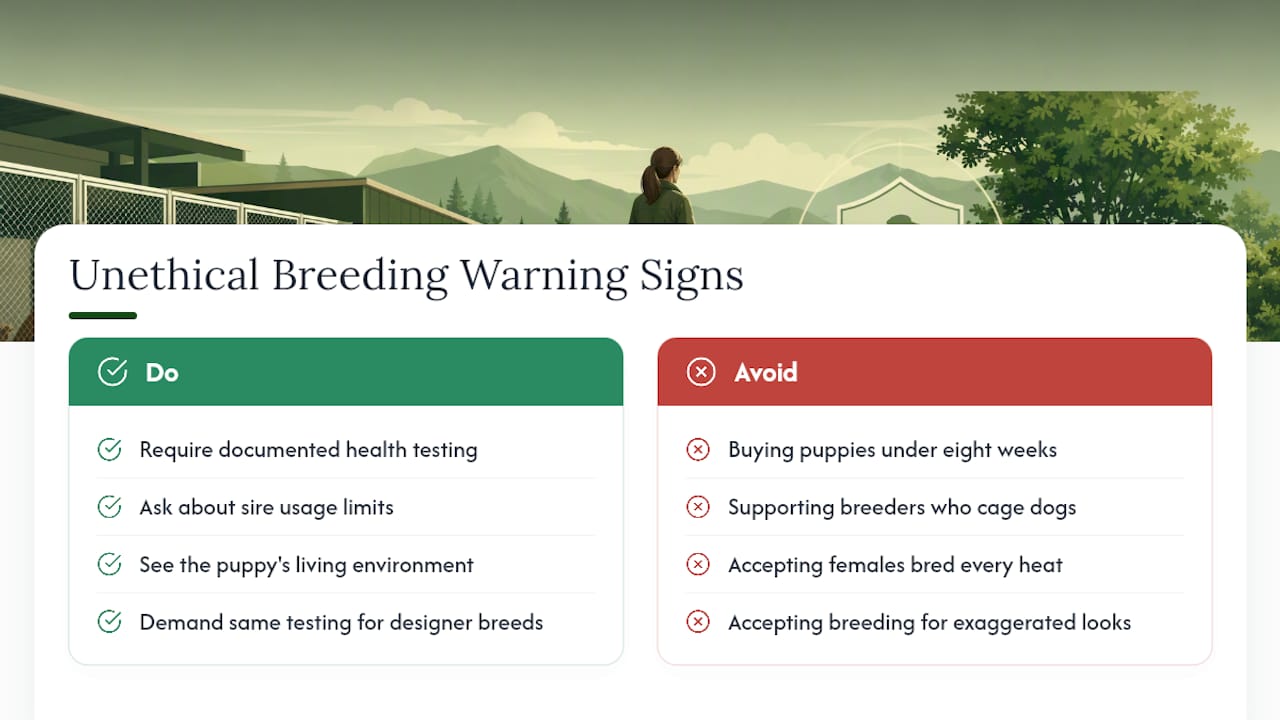
Puppy mills share a recognizable set of indicators: dogs kept in cages rather than living spaces, no health testing, breeding females used on nearly every heat cycle with little recovery, and puppies sold before eight weeks old through a third party who never lets you see where the puppy actually came from.
Breeding purely for appearance causes its own separate harm. Academic review of fashionable dog breeding documents how selecting for exaggerated features, extremely short muzzles being the clearest case, produces brachycephalic obstructive airway syndrome (BOAS), a condition that leaves dogs struggling to breathe normally for their entire lives. The same review points to a broader pattern: prioritizing a look over function tends to concentrate health problems rather than eliminate them.
Genetic bottlenecks compound the problem. The popular-sire effect means a handful of males can end up as ancestors to a disproportionate share of a breed within a few generations, shrinking the gene pool and making hereditary disease harder to breed out later. This is exactly why the numeric limits on sire usage exist in serious breeding guidance, not as bureaucracy, but as a hedge against a breed narrowing itself into trouble.
Designer breeds carry a quieter risk. Because crosses like many “doodle” mixes fall outside formal breed registries, they often escape the structured health monitoring that purebred lines have built up over decades. That’s not an argument against crossbred dogs. It’s an argument for demanding the same testing rigor from a designer-breed breeder that you’d expect from any purebred program, since no registry is doing that verification for you automatically.
Your Step-by-Step Checklist for Finding an Ethical Breeder
Verification gets easier when you break it into a sequence rather than trying to judge everything from one phone call.
- Start with reputable sources. Breed clubs, veterinary referrals, and breeders who publish their health testing openly are a better starting point than a general classifieds search.
- Ask targeted questions early. Health tests, temperament of the parents, and the breeder’s return policy should all come up before you discuss price.
- Arrange an in-person visit. If distance makes that hard, ask for a live video walkthrough of the space and the puppies, and treat refusal as a warning sign.
- Verify every document. Cross-check test results against the certifying organization rather than taking a printout at face value.
- Get a vet involved before final payment. An independent check, even a brief one, is worth the cost relative to a puppy’s lifetime.
Reasonable breeders run waitlists and take modest deposits to hold a spot in an upcoming litter. That’s normal. What’s not normal is being pressured to pay the full amount, sight unseen, before any health information has been shared, or being told a deposit is “non-refundable no matter what you find out later.” A written take-back or return policy is worth asking for explicitly, in writing, before you commit.
Pro Tip: If a breeder can’t tell you, off the top of their head, what health issues affect their specific breed and how they screen for them, that’s a bigger red flag than a messy kennel. Knowledge gaps predict future problems better than a dirty floor does.
How Lakewoodranchdoodles Approaches Ethical Breeding in Practice
Lakewoodranchdoodles has spent more than 20 years raising Goldendoodles, Bernedoodles, and Cockapoos with a focus on service-animal-quality temperament, strong health, and trainability that holds up in real homes, not just in a breeder’s yard. That timeline matters because temperament and health outcomes in a breeding program only become clear across multiple generations, not one or two litters.
Our approach leans holistic, meaning nutrition, socialization, and veterinary care are treated as connected pieces rather than separate boxes to check. You can read more about how those holistic practices support healthier dogs and how puppy health testing fits into that framework before a puppy ever goes home.
What you should expect to see and be able to verify: health records tied to specific tests, our licensing documentation, a structured go-home kit, and evidence of daily socialization rather than a claim about it. We welcome scrutiny here, because a claim you can’t check isn’t worth much to either of us.
Visits happen by appointment, and we also do virtual visits for families who can’t make the drive, so distance is not a reason to skip verification. If you want to confirm any of it directly, our breeding license and program details are both public, and we’ll put you in touch with our veterinarian if you want an independent answer on a specific health test. Lifetime breeder support isn’t a slogan on our site. It’s the same phone number you called for your first inquiry, still answering years later.
Where Most Buyers Get This Wrong
Most advice on ethical breeding focuses almost entirely on health test paperwork, and paperwork matters, but it’s not where most bad decisions actually happen. The bigger failure point is buyers accepting a breeder’s word instead of independently checking a single number against a testing registry, or skipping the in-person visit because a video call felt convenient enough.
The evidence here, from the ASPCA’s lifetime-responsibility standard to the AKC’s temperament guidance, points to a simple priority order: verify documentation first, observe temperament and handling second, and treat price as the least important factor in the entire decision. A cheap puppy with no verifiable testing costs more over a lifetime than a properly screened one ever will, in vet bills if nothing else.
What deserves more weight than it usually gets is the take-back policy. It’s the one commitment a breeder can’t fake with a nice website or a good photo. If they won’t put it in writing, that tells you what you need to know before you ask another question.
— Lakewood
Ready to Bring Home a Puppy Bred the Right Way?
Reading about health testing, inbreeding limits, and take-back policies is one thing. Finding a breeder who actually delivers on all three is the harder part, and it’s exactly what Lakewoodranchdoodles has built its program around for more than two decades. We raise Goldendoodles, Bernedoodles, and Cockapoos with documented health screening, structured socialization, and a lifetime commitment to every dog we place, backed by daily visits by appointment and virtual visits if distance is a factor.
If you’re ready to see what that looks like in practice, browse our available Goldendoodle puppies or check our upcoming litters to see what’s coming next. Families looking for a dog suited to service or emotional support work can also review our service and emotional support dog program. Call us at 705 875 5195 or reach out through our site to schedule a visit and ask us anything you learned in this guide. We’d rather answer a hard question now than have you wonder about it later.
Sources
For deeper reading beyond this guide, the ASPCA’s position statement lays out the welfare criteria regulators and shelters use to judge breeding operations. The AKC’s breeder guide is the most detailed walkthrough of health testing and breeder education available from a major registry. Adapted guidance from the EU’s RSPCA gets specific on inbreeding coefficients and conformation risks. The Royal Kennel Club’s introduction to breeding is a solid primer on timing and preparedness. The PMC review on fashionable breeding explains the science behind conformation-related suffering. For anything breed-specific, a conversation with your own veterinarian will interpret test results better than any general guide can.
- Position Statement on Criteria for Responsible Breeding | ASPCA
- AKC’s Guide to Responsible Dog Breeding
- Responsible dog breeding guidance (adapted from RSPCA Australia) | EU animal welfare platform
- Ethical concerns about fashionable dog breeding – PMC (NIH)