


Restrain your puppy, keep them off your lap and out of the front seat, and follow Ontario’s distracted-driving rules every single trip. The Ontario SPCA and the AVMA both back graduated car exposure for young dogs, and SafePass Driving School confirms that while Ontario has no single pet-restraint statute, distracted-driving and careless-driving provisions apply the moment your puppy interferes with your control of the vehicle.
Before you start the car, run through this quick checklist:
- Puppy secured in a crash-tested harness or anchored crate in the back seat
- No puppy on the driver’s lap or in the front seat
- Child locks engaged on rear doors
- Water and a travel bowl packed for stops
- Vet contact and ID tag confirmed
Key Takeaways
Restraining your puppy in a crash-tested harness or anchored crate in the back seat is the single most effective step for safe puppy travel on Ontario roads.
| Point | Details |
|---|---|
| Restrain every trip | Use a crash-tested harness or anchored crate in the back seat; never allow the puppy on the driver’s lap. |
| Acclimate over two weeks | Start with parked-car sessions and build to 30-minute drives; rushing this step causes anxiety and distraction. |
| Know the legal exposure | Ontario distracted-driving fines commonly range from about $615 to $1,000 for first offences; a lap-riding puppy can also trigger a Driving While Crowded charge. |
| Pack an emergency kit | Carry water, a spare leash, vet contacts, vaccination records, and clear all chip bags from the back seat before departure. |
| Lakewoodranchdoodles | Puppies leave Lindsay already crate-conditioned; the Classic Holistic Starter Kit supports a calm first drive home. |
Table of Contents
- How do you safely restrain a puppy in the car?
- How do you prepare a puppy for car travel?
- What should you do while driving with a puppy?
- What are Ontario’s laws for driving with a dog?
- What should be in your puppy’s travel health and emergency kit?
- Breeder-sourced advice from Lakewoodranchdoodles
- Lakewoodranchdoodles supports your puppy’s first ride and every one after
- Sources
How do you safely restrain a puppy in the car?
The three main options are anchored crates or carriers, crash-tested harnesses with seat-belt attachments, and pet barriers. Each suits a different situation.
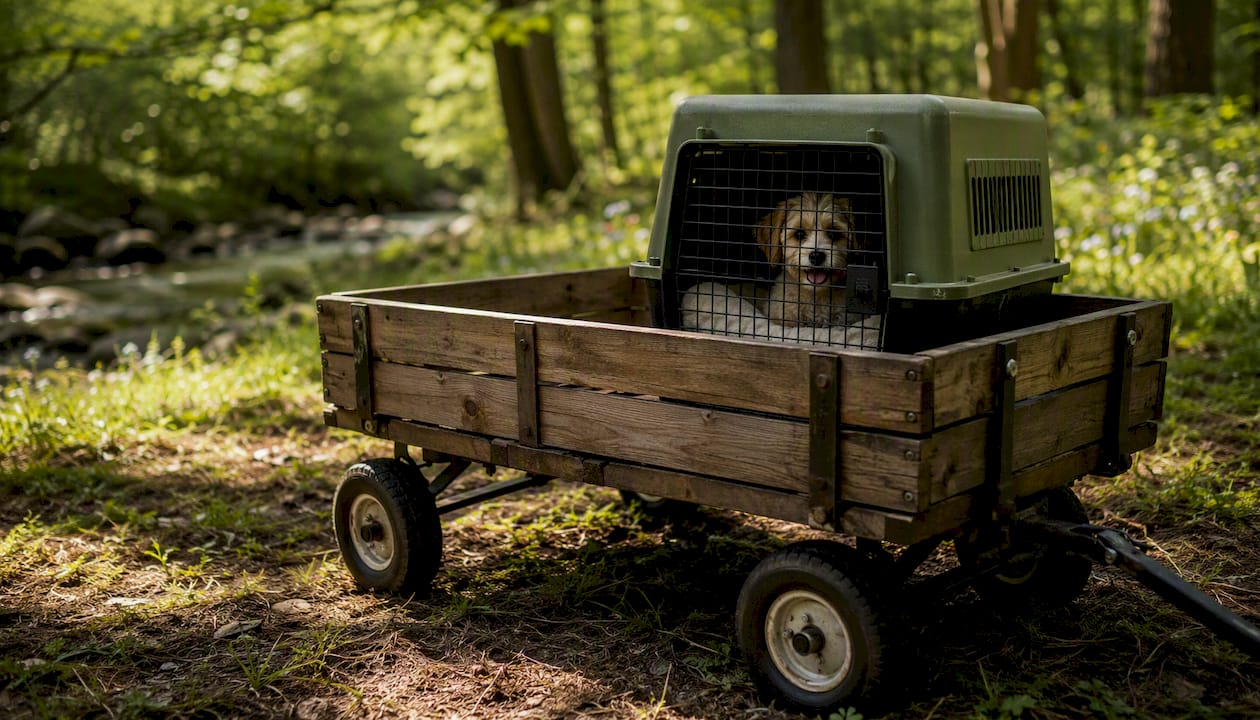
Crates and carriers work best for small puppies and multi-dog travel. A hard-sided crate placed in the cargo area or secured on the back seat with a seat-belt loop through the handle gives the most protection in a sudden stop. The crate should be large enough for the puppy to stand and turn around, but not so roomy that they slide across it on impact.
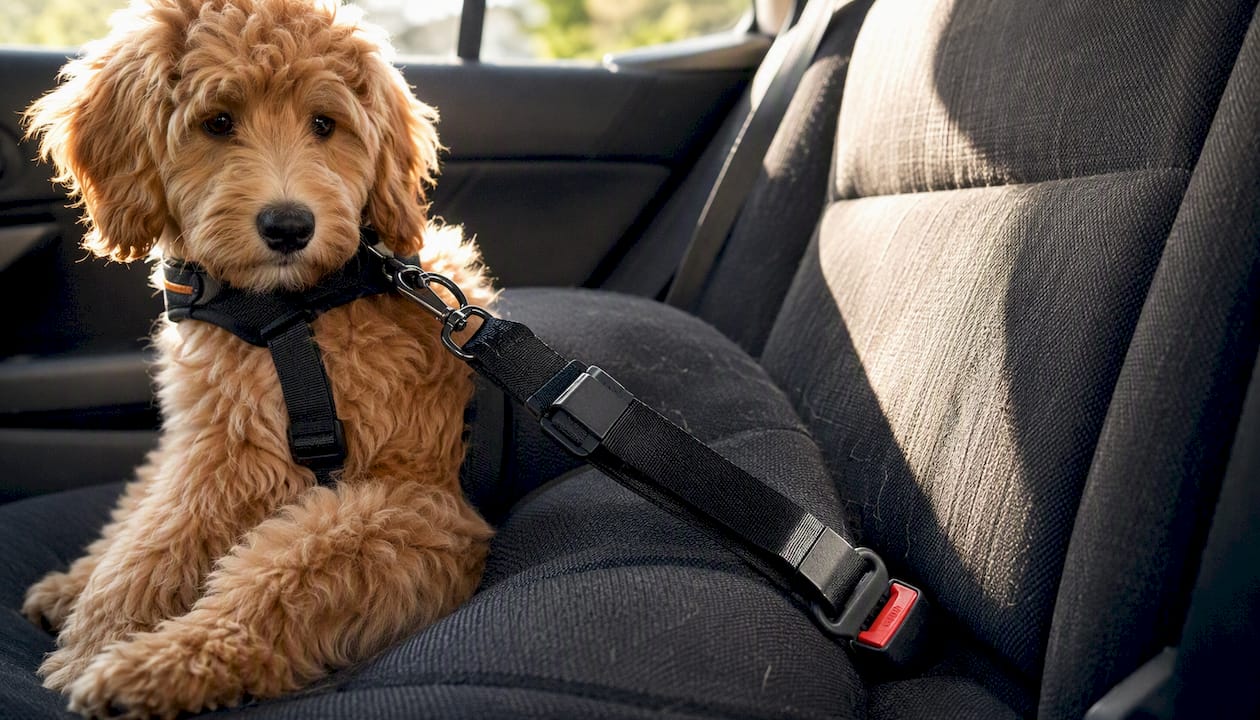
Crash-tested harnesses clip into the seat-belt buckle and spread crash forces across the chest rather than the neck. Consumer Reports recommends choosing restraints that have been tested in independent crash labs, because quality varies sharply across brands. A harness that passed a sled test at a certified facility is a different product from one that simply has a seat-belt clip sewn on.
Pet barriers keep a dog in the cargo area but offer no protection if the vehicle rolls or stops hard. They are a reasonable secondary layer, not a standalone solution.
Fit and anchor checklist:
- Harness: two fingers should fit snugly under every strap; the back clip should sit between the shoulder blades, not on the neck
- Crate anchor: pull the crate firmly in three directions after securing; it should not shift more than an inch
- Seat-belt attachment: the belt should be taut with no slack loop that could let the puppy fly forward
Front-seat and airbag risk: Progressive’s driving-safety guidance notes that a puppy in the front seat can be struck by a deploying airbag and can also block the airbag from protecting the driver. Back seat only, every time.
Pro Tip: Before your first real drive, do a two-minute parking-lot test. Put the puppy in their harness or crate, give a gentle tug on the attachment point, then drive a slow loop and brake moderately. If anything shifts or the puppy can reach the front seat, adjust before you hit the road.
How do you prepare a puppy for car travel?
Anxiety and motion sickness are the two things that make early car rides miserable for puppies and distracting for drivers. A two-week acclimation schedule fixes most of it.
Week 1: Build the association slowly
- Day 1: Let the puppy sniff and explore the parked car with the engine off. Reward calm behavior with small treats.
- Day 2: Put the puppy in their crate or harness in the back seat for five minutes, engine still off. Treat and praise.
- Day 3: Start the engine and idle for two minutes. No movement yet.
- Day 4: Drive one block and return. Keep it under five minutes.
- Days 5–7: Gradually extend to 10-minute drives around quiet streets.
Week 2: Build duration and confidence
- Days 8–10: 15–20-minute drives, including a stop where the puppy gets out on leash for a short walk.
- Days 11–14: Introduce a 30-minute drive with one planned potty stop. Practice entering and exiting the car calmly on leash every time.
For crate acclimation, the same positive-reinforcement steps apply: feed meals near the crate, then inside it, before ever closing the door. A puppy that already loves their crate at home will settle faster in the car.
What to bring on every trip:
- A blanket or small toy from home (familiar scent reduces stress)
- Bottled water and a collapsible travel bowl
- Small, low-value treats for rewarding calm behavior
- A towel for cleanups
Troubleshooting common problems:
- Whining: usually fades after the first few trips if you ignore it and reward silence; do not stop the car in response to whining or it becomes a trained behavior
- Drooling heavily: a sign of nausea; withhold food for two to three hours before the trip and keep the car cool
- Vomiting: one episode can be normal; two or more trips in a row with vomiting warrants a vet call to discuss anti-nausea options
The Ontario SPCA notes that puppies between roughly 4 and 12 weeks have fragile immune protection and are more vulnerable to infectious disease. Limit exposure to other animals at rest stops during this window, and confirm your puppy’s vaccination schedule before any trip that involves public spaces or dog parks.
For more on training your puppy to respond to calm cues in and around the car, Lakewoodranchdoodles has a dedicated training resource that covers the basics from the first week home.
What should you do while driving with a puppy?
The rules here are short and non-negotiable.
Do:
- Keep the puppy in the back seat, secured at all times
- Engage child locks on rear doors before every trip
- Stop every 1–2 hours for puppies under six months: a short walk, water, and a chance to eliminate
- Pull fully off the road before interacting with the puppy
Don’t:
- Let the puppy ride on your lap. An Ontario Provincial Police advisory confirms that driving with a pet on your lap can result in a “Driving While Crowded” charge under the Highway Traffic Act, with fines around $110, or careless-driving charges with higher penalties and demerit points
- Allow the puppy to hang their head out the window at highway speeds; debris and wind pressure can cause eye and ear injuries
- Feed a full meal within two hours of departure
- Leave the puppy unattended in a parked vehicle
Heat and cold warning: A car parked in summer sun can reach dangerous internal temperatures within minutes, even with windows cracked. In winter, a parked car becomes a refrigerator. Ontario’s animal-cruelty provisions apply to leaving a pet in conditions that cause distress or injury. If you need to stop, take the puppy with you.
What are Ontario’s laws for driving with a dog?
Ontario does not have a single statute that says “restrain your pet or face a fine.” What it does have is a set of broader provisions that apply the moment your puppy becomes a distraction or a hazard.
How enforcement works in practice:
- Distracted driving: If a puppy on your lap or loose in the cabin causes you to lose control or swerve, officers can apply distracted-driving provisions. First-offence fines commonly run from $615 to $1,000, plus three demerit points.
- Driving While Crowded (HTA s. 165): A lower-tier charge for a pet physically obstructing the driver; fines around $110.
- Careless driving (HTA s. 130): Applied when a pet causes a more serious loss of control; fines up to $2,000, six demerit points, and possible license suspension.
- Animal cruelty: Leaving a pet in a vehicle in conditions that cause distress can trigger a call to animal services and charges under Ontario’s animal-welfare legislation.
Pro Tip: Check the Ontario Ministry of Transportation’s Highway Traffic Act page and your local police service’s website for current fine schedules. Amounts are updated periodically and the figures above reflect commonly cited ranges, not a guarantee of what any single officer will issue.
What should be in your puppy’s travel health and emergency kit?
A pre-trip health check takes ten minutes and prevents most roadside emergencies.
Pre-trip health checklist:
- Confirm your puppy has had their age-appropriate core vaccines; the Ontario SPCA recommends scheduling a vet check within the first week of adoption and keeping vaccines current before travel
- Rabies vaccination is required for most cross-border or provincial travel
- Check for current parasite prevention (flea, tick, heartworm as appropriate for the season)
- Do not travel with a puppy that is visibly ill, has had diarrhea in the last 24 hours, or has not yet completed their primary vaccine series for longer trips involving other dogs
Emergency kit for the car:
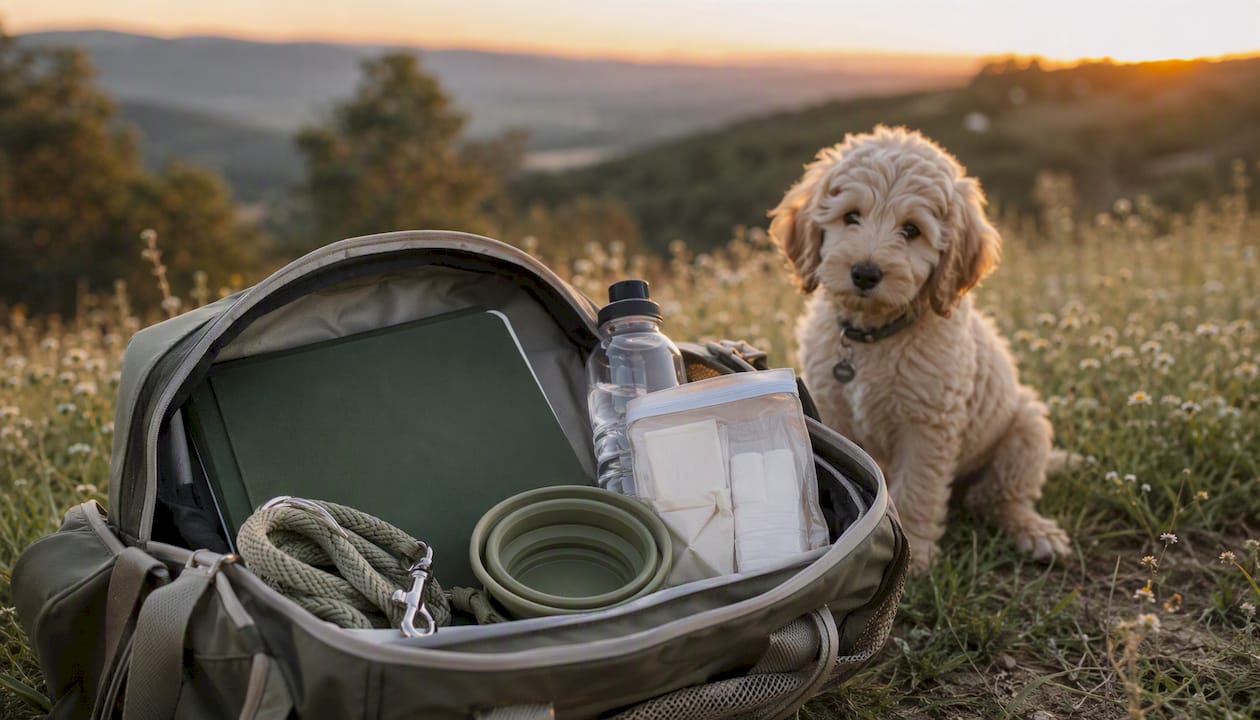
- Bottled water (enough for the full trip plus a buffer)
- Collapsible bowl and a spare leash
- Towels and a small bag for waste
- A muzzle sized for your puppy (an injured dog may bite even a familiar person)
- Your regular vet’s number, the nearest 24-hour emergency clinic on your route, and the ASPCA Animal Poison Control Center (888-426-4435)
- A copy of your puppy’s vaccination records
- ID tag confirmed on collar; microchip registration verified
One often-overlooked hazard: chip bags, cereal bags, and similar snack packaging left in the car. PreventiveVet flags these as a leading cause of pet suffocation because puppies can get their heads stuck inside and cannot back out. Clear all loose packaging from the back seat before your puppy gets in.
For veterinary services on the road, Animal Care of Hobe Sound offers a useful reference list of travel accessories and health checks recommended for pets in transit.
Breeder-sourced advice from Lakewoodranchdoodles
At Lakewoodranchdoodles, every puppy leaves Lindsay, Ontario, already familiar with a carrier. The conditioning starts early: short crate naps from the first weeks, brief car-engine exposure, and positive reinforcement every time a puppy settles calmly in a confined space. By the time a puppy goes home, the crate is a comfort zone, not a cage.
What a well-prepared puppy comes home with:
- A small blanket carrying the scent of their littermates and mother
- A brief written note on the feeding and sleep schedule they are already used to
- Basic recall and “settle” cue foundations so owners have a starting point
- Guidance on keeping your puppy calm and exercised during the first weeks, including car-ride tips
The scent item matters more than most new owners expect. A puppy that can smell something familiar in an unfamiliar car settles faster and vocalizes less, which means fewer distractions for the driver.
Lifetime breeder support means you can call or message Lakewoodranchdoodles with questions about travel anxiety, motion sickness, or crate regression at any stage of your dog’s life, not just the first week. That ongoing relationship tends to reduce unnecessary vet visits for behavioral issues that a quick conversation can resolve.
Pro Tip: On the drive home from the breeder, have a second person hold the carrier or sit beside the crate in the back seat. That first trip sets the emotional tone for every car ride that follows. A calm, quiet ride home is worth more than any training session you will do later.
A note from Lakewood Ranch on the mistakes we see most often
The most common mistake new owners make is the quick-errand lap ride. It feels harmless for a five-minute drive to the coffee shop, but it teaches the puppy that the lap is their place in the car, and that habit is genuinely hard to undo. The second most common mistake is skipping the acclimation schedule because the puppy “seems fine.” A puppy that is quiet on the first ride is often just frozen with stress, not relaxed. Build the positive association before you need it.
If you have questions about your specific puppy’s temperament or travel readiness, call us at 705 875 5195 or book a virtual visit. We are happy to walk through a pre-trip plan with you.
Lakewoodranchdoodles supports your puppy’s first ride and every one after
Every Goldendoodle, Bernedoodle, and Cockapoo puppy from Lakewoodranchdoodles comes home with a foundation already built for calm car travel. The Classic Holistic Starter Kit includes comfort items specifically chosen to ease the transition from breeder to home, including the kind of calming, familiar-scent support that makes that first drive less stressful for your puppy and safer for you.
Lakewoodranchdoodles’ holistic approach to breeding means the work of preparing your puppy for life on the road starts before you ever pick them up. Visit us in Lindsay, call 705 875 5195, or book a virtual appointment to ask about travel readiness for your specific puppy.
Sources
- What Are the Rules for Driving with a Pet in the Car in Ontario? | SafePass Driving School
- #NWRthursdaytraffictip , As much as you love your pet, drivers …
- Driving With Pets: Getting There Safely | Progressive
- Guide to safety features | Consumer Reports
- Puppy and kitten fragility - Ontario SPCA
- Pet suffocation | PreventiveVet
If a puppy shows repeated vomiting, labored breathing, or signs of heat distress during or after a trip, call your vet rather than animal control. Animal control handles welfare complaints; your vet handles medical emergencies.