


The most common puppy buying mistakes Canadian buyers make are paying untraceable deposits to unverified sellers, skipping health documentation, taking a puppy home before 8 weeks, and falling for fake online listings with stolen photos. If you’re currently in the process of buying a puppy, these six actions protect you right now:
- Refuse any payment by wire transfer, cryptocurrency, or Western Union before you have a signed contract.
- Request a live video call showing the puppy, the mother, and the home environment.
- Ask for vet records dated within the past week, vaccination dockets, and deworming history.
- Insist on a written sales contract with a health guarantee before sending any money.
- Run every listing photo through Google Reverse Image Search and check the seller’s domain via WHOIS if they have a website.
- Report suspicious sellers to the Canadian Anti-Fraud Centre immediately.
Pro Tip: Never send a full payment or a nonrefundable deposit until you have completed a live video verification and received a signed contract. Scammers rely on urgency. A real breeder will wait.
Key Takeaways
Avoiding common puppy buying mistakes in Canada comes down to one discipline: verify identity, documentation, and payment safety before you send a single dollar.
| Point | Details |
|---|---|
| Verify before you pay | Run a reverse-image search, request live video, and confirm vet records before any deposit. |
| Use traceable payment only | Credit cards and traceable bank transfers with a signed contract are the only safe options. |
| Know the normal price range | Doodle breeds in Canada generally have a typical purchase price range, and prices far below typical market value should be treated with caution. |
| Puppies go home at 8 weeks minimum | Any seller pushing earlier pickup is violating both best practice and provincial law in many provinces. |
| Report scams immediately | Contact the Canadian Anti-Fraud Centre and your bank the same day you suspect fraud. |
Table of Contents
- 1. The Top 10 Common Puppy Buying Mistakes in Canada
- 2. How online puppy scams work and the exact red flags to watch for
- 3. A step-by-step verification checklist before you pay anything
- 4. Safe payment methods and what to do if something goes wrong
- 5. Realistic costs and timelines so you can spot a rushed or underpriced deal
- 6. What a responsible breeder should provide: a checklist you can use
- 7. Legal protections and buyer rights when purchasing a puppy in Canada
- What most puppy-buying advice gets wrong
- Sources
1. The Top 10 Common Puppy Buying Mistakes in Canada
These are the mistakes that cost Canadian buyers money, heartbreak, or both. Documented buyer errors consistently cluster around the same patterns, so recognizing them in advance is your first real defense.
1. Buying on impulse after seeing a cute photo You see a listing on Kijiji or Instagram, fall in love with the photo, and send a deposit the same day. Weeks later, the puppy either never arrives or arrives sick. Impulse buys skip every verification step that matters.
2. Chasing a suspiciously low price A Goldendoodle listed at $400 when the going rate is $2,500–$4,000 is not a deal. It is a signal. Underpriced puppies often come from puppy mills, backyard breeders with no health testing, or outright scammers.
3. Never meeting the parents Temperament is largely inherited. A buyer who never sees the mother has no way to assess whether the puppy’s adult behavior will match what was advertised. Reputable breeders expect you to ask.
4. Skipping health documentation Vaccination records, deworming history, and a recent vet exam are not optional extras. Skipping them means you have no baseline for the puppy’s health and no legal recourse if problems emerge within days of pickup.
5. Taking a puppy home before 8 weeks Puppies removed from their litter before 8 weeks miss a critical socialization window. The result is often increased anxiety, aggression, and difficulty with training. In several Canadian provinces, selling a puppy under 8 weeks is prohibited.
6. Choosing a breed based on looks alone A buyer who picks a high-energy breed because it photographs well, then discovers it needs two hours of daily exercise, is setting up both the dog and themselves for frustration. Breed research before the search saves years of regret. If you’re unsure which breed fits your lifestyle, the companion dog guide for Canadian buyers is a useful starting point.
7. Trusting social-media-only sellers A polished Instagram page with puppy photos proves nothing. Scammers build convincing profiles in hours. Social media presence without a verifiable address, phone number, and references is not a trust signal.
8. Falling for shipping-fee and transport scams The seller confirms the puppy, then requests additional fees for “transport crating,” “insurance,” or “customs clearance.” Each payment unlocks another fee. The puppy never arrives. This is one of the most common scam structures targeting Canadian buyers, particularly around the holidays when online puppy scam reports spike.
9. Paying by untraceable methods Wire transfers, cryptocurrency, and prepaid gift cards leave you with no recourse once the money leaves your account. A legitimate breeder will never insist on these.
10. Skipping breeder references and registration checks Asking for two or three references from previous buyers takes five minutes and can save thousands of dollars. Canada has no single national breeder licensing system, so references and breed club affiliations are among the most reliable accountability proxies available.
2. How online puppy scams work and the exact red flags to watch for
Scammers follow predictable playbooks. Once you know the structure, the warning signs are hard to miss.
The fake listing: A scammer posts professional-looking photos of a puppy (usually stolen from a legitimate breeder’s website or social media) on Kijiji, Facebook Marketplace, or a classified site. The price is low, the breed is popular, and the seller is “motivated.” After you express interest, they ask for a deposit via e-transfer or wire. The puppy does not exist.
The shipping-fee escalation: You pay a deposit. The seller confirms the puppy is ready, then introduces a series of fees: transport crate, airline insurance, customs clearance, a “refundable health bond.” Each payment is framed as the last one. Humane Canada’s toolkit specifically flags shipping-only offers and requests for overseas payments as disqualifying red flags.
The fake vet records: Some scammers provide documents that look official but are fabricated PDFs. Check that the vet clinic name, address, and phone number are real and call to confirm the records.
The escrow impostor: The seller proposes using an “escrow service” for safety, then sends a link to a fake escrow site they control. You deposit funds; they disappear.
Red flags to watch for:
- Seller refuses a live video call or insists on photos only.
- Listing shows multiple breeds available at all times.
- Seller is located overseas or asks you to send money internationally.
- Price is well below the typical range for the breed in Canada.
- Communication is rushed, emotional, or uses pressure tactics (“another family is interested today”).
- No physical address, no verifiable phone number, no references.
- Payment must be by wire transfer, cryptocurrency, Western Union, or gift card.
- Paperwork arrives as a generic PDF with no verifiable clinic or registration details.
Pro Tip: Run every listing photo through Google Images or TinEye before engaging with a seller. If the same photo appears on multiple listings or on a breeder’s site in another country, walk away.
3. A step-by-step verification checklist before you pay anything
Follow this sequence in order. Do not skip steps because a seller seems trustworthy.
-
Reverse-image search every photo. Paste listing images into Google Images or TinEye. Stolen photos are the single most common scam indicator.
-
Confirm the seller’s physical address. Ask for a full civic address and verify it on Google Maps Street View. A real breeder has a real property.
-
Check the website domain. If the seller has a website, run the domain through a WHOIS lookup tool. A domain registered within the past few weeks is a red flag.
-
Request a live video call. Ask to see the puppy moving, the mother, and the space where the litter is raised. Scammers cannot produce a live puppy on demand.
-
Ask the ten questions the CKC recommends. These include registration status, health clearances for the parents, whether you can visit, and whether the puppy has been vet-checked before sale.
-
Request vet records dated within the past week. A clear, dated veterinary exam and documented vaccination and deworming history is the strongest immediate evidence of baseline medical care.
-
Verify the vet clinic independently. Call the clinic directly using a number you find yourself, not one the seller provides. Confirm the puppy’s records are on file.
-
Ask for two or three references from previous buyers. Call them. Ask specifically about the health of their puppy and whether the breeder provided post-sale support.
-
Review the written contract before any payment. The contract should include a health guarantee, a return policy, payment terms, and the breeder’s full contact information. For a detailed breakdown of what health guarantees should cover, the Canadian buyer’s guide to puppy health guarantees is worth reading before you sign anything.
-
Confirm the pickup age. No reputable breeder releases a puppy before 8 weeks. If the seller pushes for earlier pickup, that is a disqualifying signal.
Pro Tip: If a seller resists any step in this checklist, treat it as a hard stop. Legitimate breeders welcome scrutiny. They have nothing to hide and everything to gain from a well-informed buyer.
4. Safe payment methods and what to do if something goes wrong
Payments to avoid:
- Wire transfers to personal accounts.
- Cryptocurrency of any kind.
- Western Union or MoneyGram.
- Prepaid gift cards (a request for these is an immediate scam signal).
- E-transfers with no written contract attached.
Safer alternatives:
- Credit card payments, which carry chargeback rights if the transaction is fraudulent.
- Traceable bank transfers accompanied by a signed contract and written receipt.
- Third-party escrow services, but only ones you locate independently and verify as legitimate.
Keep deposits proportional. A reasonable deposit on a puppy is typically a fraction of the total price, paid only after you have completed live verification and received a signed contract. A seller demanding the full purchase price upfront before you have met the puppy in person or via live video is a warning sign.
If something goes wrong:
- Contact your bank or credit card issuer immediately and request a chargeback. Time matters; most issuers have a reporting window.
- File a report with the Canadian Anti-Fraud Centre online or by phone.
- File a report with your local police service, especially if you have lost a significant amount of money.
- Preserve all evidence: screenshots of the listing, all chat logs, emails, payment receipts, and any documents the seller provided.
- Report the listing to the platform where you found it (Kijiji, Facebook Marketplace, etc.) so it can be removed.
5. Realistic costs and timelines so you can spot a rushed or underpriced deal
Understanding what a normal puppy purchase looks like in Canada makes suspicious offers much easier to identify.
Typical timeline:
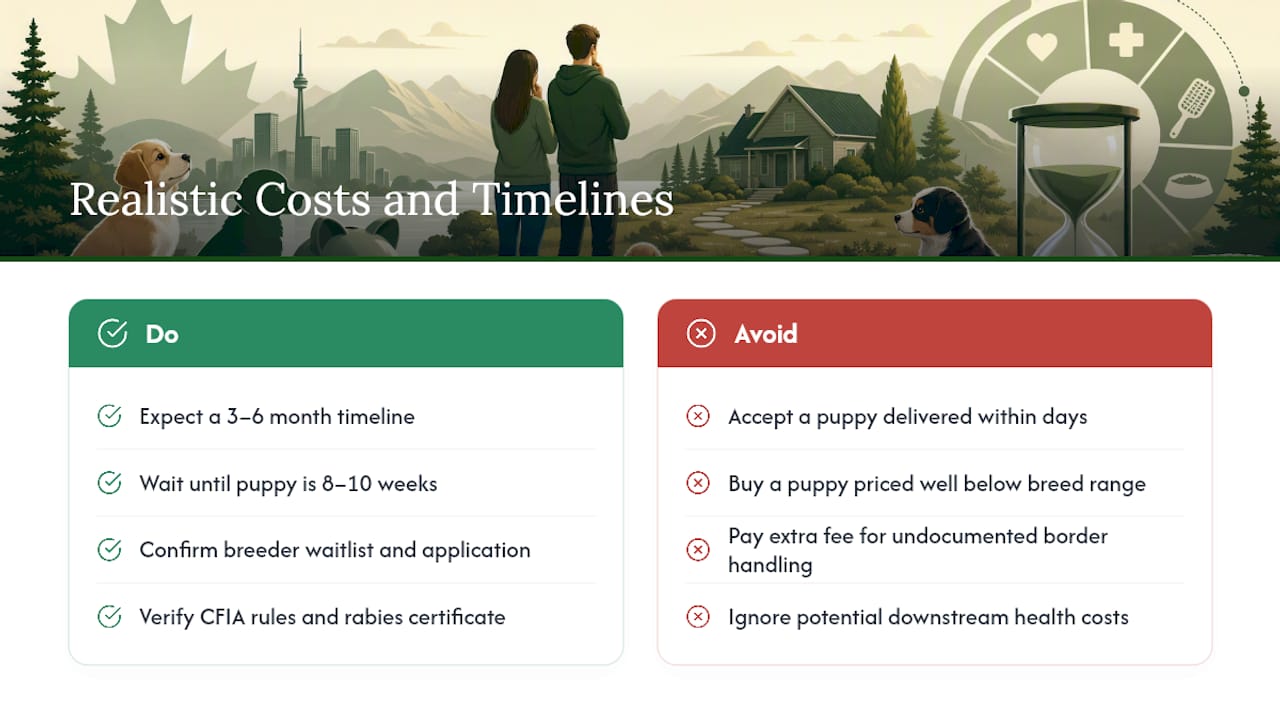
A reputable breeder usually has a waitlist. After you submit an application and pay a deposit, you wait for a litter to be born, then for the puppies to complete their socialization period. Puppies go home at 8 weeks at the earliest, and many breeders prefer 8–10 weeks. From first inquiry to pickup, the realistic timeline is often 3–6 months. A seller who can deliver a puppy within days of your first contact, with no waitlist and no application process, is almost certainly not operating a legitimate breeding program.
Typical costs in Canada:
A puppy listed well below the typical purchase price range for its breed is either from a puppy mill, a backyard breeder with no health testing, or a scam. The downstream costs of a puppy with undisclosed health problems, documented by veterinary sources, routinely exceed the apparent savings on the purchase price.
Cross-border purchases: Importing a puppy from the United States into Canada requires a valid rabies vaccination certificate for dogs over 3 months old, and the puppy must meet Canadian Food Inspection Agency (CFIA) requirements. Additional transport, crating, and border documentation costs apply. Sellers who offer to handle all of this for an extra fee, without providing verifiable documentation, are a common scam vector. Budget for these costs and verify the requirements directly with the CFIA before agreeing to any cross-border transaction. For ongoing care costs after pickup, the caring for your dog resource gives a practical overview of what to expect in the first year.
6. What a responsible breeder should provide: a checklist you can use
Because Canada has no single national breeder licensing system, the burden of verification falls on the buyer. The good news is that responsible breeders leave a clear paper trail and behave in consistent, recognizable ways.
Trust signals a reputable breeder will demonstrate:
- Screens buyers with an application and asks questions about your lifestyle, home, and experience with dogs.
- Allows in-person visits or live video calls to see the puppies and the parents.
- Provides parent health clearances (OFA hip/elbow evaluations, eye certifications, or breed-specific genetic tests as appropriate).
- Offers a written health guarantee covering genetic conditions for a defined period.
- Provides a written sales contract with a return policy if the placement does not work out.
- Gives you the contact information for their veterinarian and encourages you to call.
- Offers post-sale support and is reachable after the puppy goes home.
- Does not release puppies before 8 weeks.
Documents to request and what to check:
| Document | What to verify |
|---|---|
| Vaccination docket | Dates, vaccine names, administering vet’s signature and clinic name |
| Deworming record | Dates and product used, consistent with puppy’s age |
| Vet exam certificate | Dated within days of sale, signed by a licensed veterinarian |
| Microchip certificate | Chip number, registration database, and your contact details |
| Parent health clearances | OFA or equivalent test results, dated and tied to named parent dogs |
| Sales contract | Health guarantee terms, return policy, payment schedule, breeder contact info |
Lakewoodranchdoodles, based in Lindsay, Ontario, offers an example of what this looks like in practice: over 20 years of breeding experience, documented health testing, lifetime breeder support, and both in-person and virtual visits by appointment. Their breeding program page outlines the specific practices buyers should expect from any responsible breeder. Their breeding license page also shows the kind of credential documentation buyers should ask to see.
7. Legal protections and buyer rights when purchasing a puppy in Canada
Canada’s legal framework for puppy buyers is a patchwork, not a single national standard. Understanding what protections actually exist, and where the gaps are, helps you set realistic expectations.
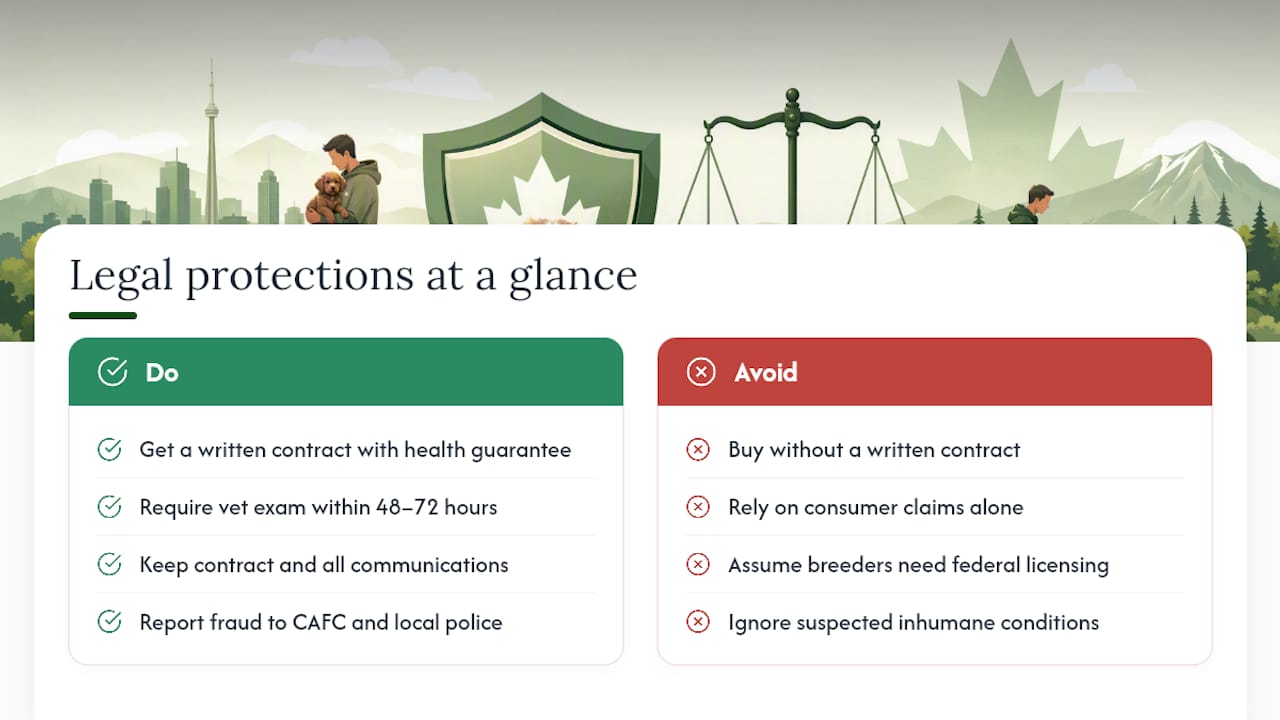
No national breeder licensing: There is no federal law requiring dog breeders to be licensed in Canada. Oversight is provincial, and the rules vary significantly. Ontario’s Dog Owners’ Liability Act addresses ownership liability but does not regulate breeding practices in detail. Several provinces have animal welfare legislation that sets minimum standards for care, but enforcement is inconsistent.
Provincial consumer protection: Most provinces have consumer protection legislation that covers contracts for the sale of goods, which includes puppies. In Ontario, the Consumer Protection Act gives buyers recourse if a seller misrepresents what they are selling. If a puppy is sold as healthy and arrives with an undisclosed condition, you may have grounds for a claim. Keep your written contract and all communications as evidence.
Animal welfare laws: The federal Health of Animals Act governs the import and transport of animals across borders and sets minimum welfare standards for animals in transit. Provincially, organizations like the Ontario SPCA and Humane Society enforce animal welfare standards. If you suspect a breeder is operating a puppy mill or keeping animals in inhumane conditions, you can report to your provincial animal welfare authority.
Buyer protections in practice: The most reliable protection is a written contract with a clear health guarantee. Reputable breeders include a clause requiring the buyer to have the puppy examined by a licensed veterinarian within 48–72 hours of pickup, with a defined remedy (replacement, refund, or contribution to vet costs) if a health problem is found. Without a written contract, your legal options are limited to general consumer protection claims, which are slower and less certain.
Reporting fraud: Online puppy fraud is a criminal matter. Report it to the Canadian Anti-Fraud Centre and your local police. If the seller is in another country, the CAFC can coordinate with international partners.
What most puppy-buying advice gets wrong
Most guides on this topic spend the majority of their words on scam mechanics and not enough on the structural reason Canadian buyers are vulnerable in the first place: there is no licensing floor. In most regulated industries, a bad actor has to clear some minimum bar to operate. In Canadian dog breeding, they do not. That means the entire burden of quality control sits with the buyer, and most buyers do not know that going in.
The conventional advice to “just buy from a reputable breeder” is technically correct and practically useless without a framework for what reputable actually looks like. The CKC’s ten questions are a good start, but they are a floor, not a ceiling. A seller who answers all ten questions smoothly and still refuses a live video call, or insists on wire transfer, has failed the test that matters most.
The other thing most guides underweight is timing. Scam reports spike around the holidays and in early spring, when demand for puppies is highest and buyers are most emotionally motivated. Urgency is the scammer’s primary tool. The single most protective habit a buyer can develop is slowing down deliberately, especially when a seller is pushing for a fast decision. A puppy genuinely available from a legitimate breeder will still be available after you have completed full verification. If it will not, that tells you everything.
The buyers who get hurt are not naive. They are people who did some research, found a listing that looked credible, and then let a combination of excitement and artificial urgency compress the verification process. The checklist in this article exists to make that compression harder.
Sources
- Ten Questions To Ask The Breeder | CKC
- What to Know Before Getting a Dog - Toolkit
- How to Find a Reputable Breeder in Canada - 7 Proven Tips
- 12 Costly Mistakes People Make When Buying a Puppy
- Avoiding holiday pet scams (news coverage)
Recommended
- Types of Puppy Health Guarantees: A Canadian Buyer’s Guide – Lakewood Ranch Doodles
- Best Companion Dogs for Seniors in Canada: 2026 Guide – Lakewood Ranch Doodles
- Kimberleeskennels.com Alternatives for Canadian Dog Owners – Lakewood Ranch Doodles
- What Puppy Cold Weather Care Means for New Owners – Lakewood Ranch Doodles