


A Bernedoodle’s “generation” is shorthand for its breeding path, meaning how much Poodle and how much Bernese Mountain Dog make up its DNA. F1 is a straight 50/50 cross, F1B leans back toward Poodle for a curlier, lower-shedding coat, and F2 and multigen dogs come from two Bernedoodle parents rather than a purebred.
If you want the best odds of a low-shedding, allergy-friendlier coat, look at an F1B or F1BB. If you want a more classic “fluffy dog” look and don’t mind moderate shedding, an F1 is usually the better match. Breeders confirm generation math with tools like Embark genetic testing and OFA orthopedic clearances, and the American Kennel Club documents the health traits both parent breeds pass down. Lakewoodranchdoodles has bred doodles for over 20 years and screens every litter before it’s offered to a family.
- F1 = approximately half Poodle and half Bernese Mountain Dog
- F1B = a higher proportion of Poodle due to breeding F1 back to a Poodle
- F2 = two F1 Bernedoodles bred together
- Multigen = any generation past F2, bred for consistency
Key Takeaways
Coat predictability rises with Poodle percentage, but health testing and breeder transparency matter more than any generation label for a successful long-term match.
| Point | Details |
|---|---|
| Generation defines breeding path | F1 is a direct Bernese x Poodle cross; F1B, F2B, and multigen add backcrosses for coat consistency. |
| Higher Poodle % improves coat odds | F1B and F1BB give better odds of low shedding, but no generation is guaranteed hypoallergenic. |
| F2 is the least predictable | Combining two F1 parents widens the range of coat and temperament outcomes in the same litter. |
| Health clearances outrank generation | OFA, PennHIP, cardiac, eye exams, and Embark panels matter more than the F-label alone. |
| Lakewoodranchdoodles screens every litter | Over 20 years of breeding experience with documented health testing and lifetime buyer support. |
Table of Contents
- What Are Bernedoodle Generations, Exactly?
- How Generation Changes Coat and Allergy Suitability
- Temperament, Trainability, and Size by Generation
- Health Screening and What Genetics Can and Can’t Predict
- What Bernedoodles Typically Cost and Why Availability Varies
- How to Choose the Right Generation for Your Home
- What Breeders Actually Look For
- The Real Question Isn’t F1 vs. F1B
- Ready to Meet Your Future Bernedoodle?
- Frequently Asked Questions
- Sources
What Are Bernedoodle Generations, Exactly?
Every generation label starts with “F,” which stands for filial hybrid, a formal way of saying “how many breeding steps removed this dog is from the original Bernese and Poodle cross,” according to PopularDoodle’s generation breakdown. The number tells you the generation, and a “B” tells you a backcross happened, meaning that generation was bred back to a purebred Poodle to push the coat and shedding profile in a more predictable direction.
Here’s the breakdown that actually matters when you’re comparing puppies:
- F1: Cross of purebred Bernese Mountain Dog and purebred Poodle with approximately equal genetic contribution. Coat and shedding can vary widely between individual dogs.
- F1B: F1 Bernedoodle × purebred Poodle. Roughly 75% Poodle. This backcross is the generation most breeders reach for when a family needs a lower-shedding coat, a point A-Z Animals confirms in its generation comparison.
- F1BB: Further backcross of F1B Bernedoodle to Poodle, increasing Poodle traits which improves curl and reduce shedding. However, Bernese characteristics may be less pronounced.
- F2: Offspring of two F1 Bernedoodles. The average Poodle genetic contribution remains about half, but coat and size may vary considerably due to mixed genetics.
- F2B: Result of breeding an F2 Bernedoodle with a Poodle or an F1 with an F1B, increasing Poodle traits above 60% and enhancing coat predictability compared to F2.
- Multigen: Any pairing beyond F2, usually Bernedoodle × Bernedoodle across three or more generations, bred specifically for a stable, repeatable coat and temperament type.
- Reverse F1B: The exception to the rule. A “B” almost always means a Poodle backcross, but a reverse F1B is bred back to a Bernese Mountain Dog instead, which increases shedding and Bernese traits. Reputable breeders always spell this out rather than leaving buyers to assume.
| Generation | Approx. Poodle % | Coat predictability | Hypoallergenic likelihood |
|---|---|---|---|
| F1 | ~50% | Low, varies by litter | Moderate |
| F1B | ~75% | High | Good to very good |
| F1BB | approximately 75% | Very high | Very good |
| F2 | ~50% (variable) | Low | Low to moderate |
| F2B | above 60% | Moderate to high | Good |
| Multigen | Varies, often 60–75% | High (that’s the goal) | Good to very good |
None of these percentages are guarantees. Two F1B littermates can still grow noticeably different coats, because coat genes don’t split evenly every time. Ask any breeder for parent photos, coat close-ups, and copies of health clearances before you commit to a deposit, and treat the percentage table as a probability range, not a promise.
How Generation Changes Coat and Allergy Suitability
More Poodle ancestry generally means more curl and less shedding, but no Bernedoodle, at any generation, is guaranteed hypoallergenic. What actually triggers allergies in most people isn’t the fur itself. It’s dander and saliva proteins, and a curlier coat simply traps and releases less of both into your house.
Here’s what to expect by coat type:
- Straight or wavy coats (common in F1, some F2): shed more, need weekly brushing, lower cost to groom.
- Loose curl (common in F1B, F2B): shed lightly, need brushing 2 to 3 times a week and a trim every 6 to 8 weeks.
- Tight curl (common in F1BB, well-bred multigen): shed the least, but mat easily and need near-daily brushing plus regular professional grooming.
Pro Tip: Skip the deshedding rakes made for double coats like Labradors. On a curly Bernedoodle, they tear through the coat and cause breakage. Ask your groomer for a slicker brush and a metal comb instead.
Temperament, Trainability, and Size by Generation
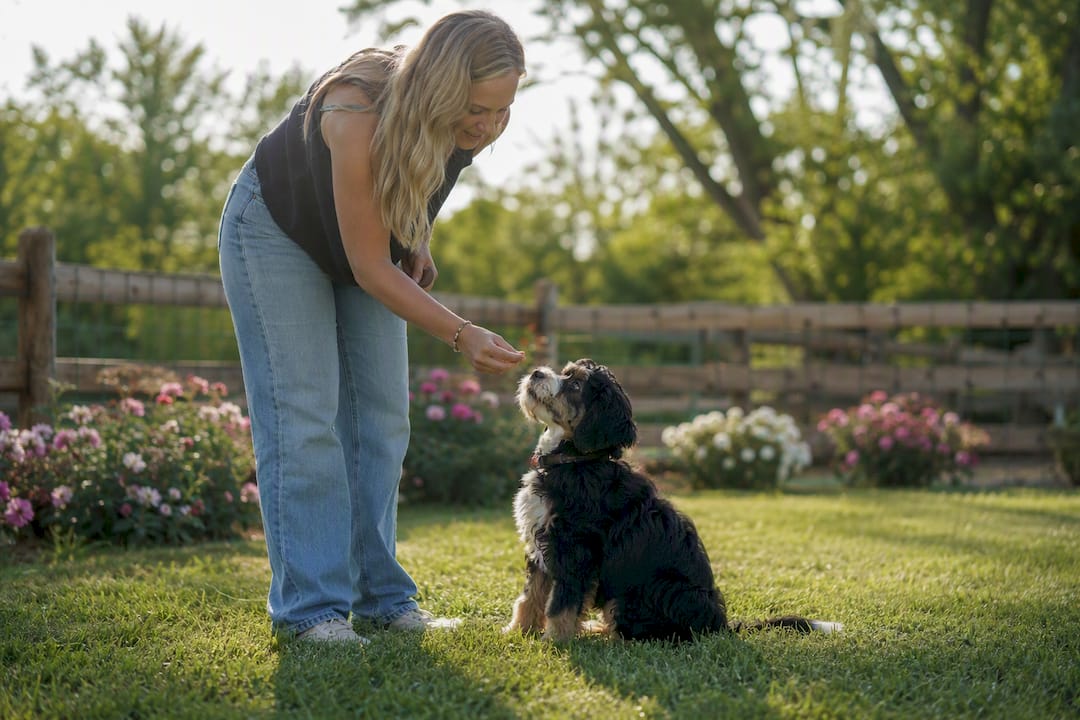
F1 Bernedoodles tend to land in the middle: a blend of the Bernese Mountain Dog’s calm, people-focused nature and the Poodle’s sharper trainability. Backcross and multigen lines, bred with more Poodle input, usually train a little faster and settle into routines more predictably. F2 dogs are the wild card. Combining two already-mixed parents widens the range of outcomes, so one F2 puppy might act like a Poodle and its littermate might act like a Bernese.
Size depends far more on which Poodle size was used in the original cross, standard, miniature, or toy, than on the generation label itself. An F1B bred from a standard Poodle can outweigh an F2 bred from a mini.
- Allergy-focused households: lean F1B, F1BB, or a well-documented multigen line.
- First-time owners: F1 or F1B, both known for an easygoing, biddable temperament.
- Active families with kids: any generation works if socialization starts early, but standard-sized F1B and multigen dogs tend to have more predictable energy levels.
- Apartment dwellers: mini or toy-based F1B lines usually fit better than standard-sized F1s.
Every generation benefits from consistent training and early socialization. Genetics influence tendencies, but early life environment shapes behavior.
Health Screening and What Genetics Can and Can’t Predict
Ask for health clearances before you ask about coat color. That single habit weeds out more bad breeders than any other question you can ask. The Bernese Mountain Dog’s breed profile flags hip dysplasia, elbow dysplasia, and certain cancers as concerns worth screening for in any hybrid carrying Bernese ancestry.
Request these results on both parents:
- Hip and elbow evaluations through OFA or PennHIP.
- Cardiac clearance from a veterinary cardiologist.
- Eye exam (CAER) within the past 12 months.
- Genetic panel through a service like Embark, screening for breed-specific markers and degenerative conditions.
Mixing two breeds sometimes produces hybrid vigor, a broader gene pool that can dilute the concentration of inherited issues found in either purebred line. But that effect isn’t automatic, and it isn’t a substitute for testing. Multigenerational breeding, done carelessly, can just as easily concentrate risk if breeders reuse related lines without tracking pedigree.
Pro Tip: If a breeder can’t produce OFA or Embark paperwork on request, treat that as a hard stop, not a maybe.
What Bernedoodles Typically Cost and Why Availability Varies
Generation moves price, but it’s rarely the biggest factor. Breeder reputation, health testing, coat color, and demand for low-shedding lines usually swing cost more than the F1 versus F1B label alone.
Expect F1B and F1BB puppies to sit at the higher end of typical price ranges, largely because demand for predictable, lower-shedding coats consistently outpaces supply. F1 litters are the most common and often the most available, since they only require one Bernese and one Poodle parent rather than a Bernedoodle parent already in the program. True multigen puppies are the rarest, since they require breeders to maintain three or more generations of tracked, health-tested lines.
- Reasonable deposits are typically non-refundable but transferable to a future litter if your timing doesn’t work out.
- Ask directly what happens if the litter doesn’t produce a puppy matching your requested coat type or sex.
- Be wary of any breeder guaranteeing a specific generation’s coat outcome with total certainty. Genetics don’t work that way.
How to Choose the Right Generation for Your Home
Start with allergy tolerance and grooming willingness, then layer in temperament and budget. That order matters because coat type is the one variable you can predict with reasonable confidence from generation alone. Everything else is closer to a range than a guarantee.
- Write down your household’s real constraints: allergy sensitivity, time available for grooming, activity level, and living space.
- Ask the breeder for current photos of both parents’ coats, not stock photos from a website.
- Request OFA, PennHIP, and genetic panel results in writing, not just a verbal assurance.
- Confirm the return or rehoming policy in case a health issue surfaces later.
Watch for these red flags:
- No willingness to share health testing on either parent.
- Vague or shifting answers about which generation a puppy actually is.
- Promises that any generation is “100% hypoallergenic” or “guaranteed non-shedding.”
Good questions to ask directly: “Is this a true F1B, and can I see the Poodle parent?” “Is this generation a backcross to Poodle or a reverse backcross to Bernese?” “What health guarantee comes with this puppy in writing?”
What Breeders Actually Look For
After more than 20 years placing puppies with families, the pattern is consistent: coat curiosity gets people in the door, but temperament and health testing are what keep a placement successful for the next decade. Buyers who only ask about generation labels and skip the clearance conversation are the ones most likely to call back with a problem later.
A reputable program should show you:
- Documented hip, elbow, cardiac, and eye clearances on both parents.
- Temperament testing before puppies are matched to families, not just by generation.
- Early socialization work started before eight weeks.
- Lifetime breeder support, not a handoff after the sale.
A generation label tells you the breeding math. It doesn’t tell you whether that breeder tested for hip dysplasia, screened temperament, or will still answer your call in year seven. Ask for both.
The Real Question Isn’t F1 vs. F1B
Most guides treat generation choice like picking a phone model, more Poodle equals better, plain and simple. That framing misses what actually determines whether a family is happy five years in: temperament fit and breeder accountability, not coat math alone.
Conventional advice pushes allergy sufferers straight to F1BB without mentioning that heavier backcrossing dilutes some of the steadier Bernese temperament traits families often want in the first place. That’s a real trade-off, not a footnote. If your household values low shedding above everything else, F1B or F1BB earns its reputation. But if temperament stability and a classic doodle personality matter just as much, a well-tested F1 or thoughtfully bred multigen line deserves equal consideration.
Prioritize the breeder’s testing paperwork before the generation label. A well-documented F1 from a health-tested program beats a poorly documented F1BB every time.
Ready to Meet Your Future Bernedoodle?
Now that you know what separates an F1 from an F1B or a multigen line, the next step is simple: match that knowledge to an actual litter. Lakewoodranchdoodles has bred Bernedoodles for over 20 years, with every parent screened through OFA clearances and Embark genetic panels before a single deposit is accepted, so you’re choosing from documented lines rather than guesswork.
Families come to Lakewoodranchdoodles specifically because generation transparency isn’t an afterthought here. If you want a lower-shedding, allergy-friendlier coat, browse the F1B Bernedoodle females currently in the program. If a classic F1 blend fits your household better, the F1 Bernedoodle females page shows current breeding stock and clearances. For a full look at what’s ready now, visit the available puppies page and reach out with your household’s specific needs. Lakewoodranchdoodles also offers virtual visits, so you can ask generation questions directly before ever setting foot on the property.
Frequently Asked Questions
What is the difference between F1 and F1B Bernedoodle?
What does F2 Bernedoodle mean? An F2 Bernedoodle comes from two F1 Bernedoodle parents rather than a purebred parent. Coat type and shedding are less predictable than F1B or multigen lines because both parents already carry mixed genetics.
Which Bernedoodle generation is best for allergies? F1B, F1BB, and well-bred multigen lines generally offer the best odds of a lower-shedding, allergy-friendlier coat, since they carry a higher percentage of Poodle ancestry. No generation is guaranteed fully hypoallergenic.
Is a multigen Bernedoodle a purebred? No. Multigen means multiple generations of Bernedoodle-to-Bernedoodle breeding, bred for a consistent coat and temperament, but it’s still a hybrid, not a recognized purebred line.
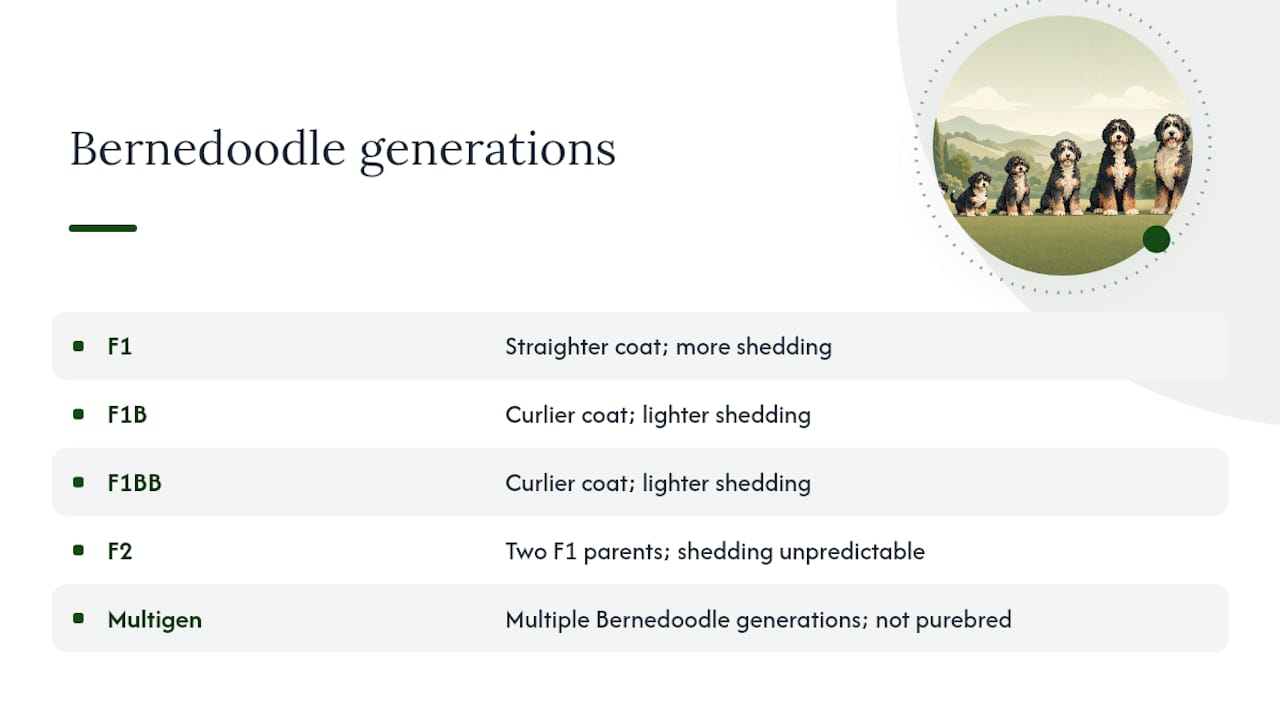
Do all Bernedoodle generations shed? Every generation sheds to some degree. Straighter-coated F1 and F2 dogs shed more noticeably, while curlier F1B, F1BB, and multigen dogs shed lightly but still require regular grooming to prevent matting.
Sources
- Poodle | American Kennel Club
- Bernedoodle generations explained (F1, F1B, F1BB, F2, F2B, F2BB, F3, Multigen) | PopularDoodle
- F1 vs F1B vs F2 Bernedoodle: What’s the Difference? | A-Z Animals