


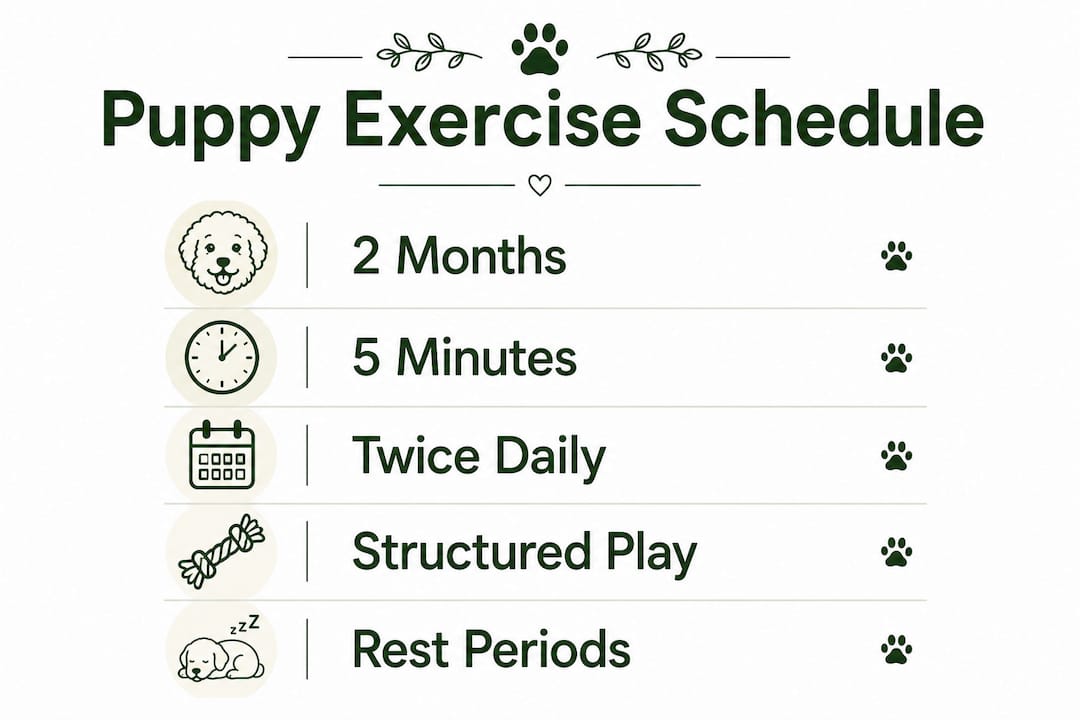
Appropriate puppy exercise is defined as short, structured sessions of low-impact physical activity combined with play and training, tailored to a puppy’s age and developmental stage. The widely accepted “five-minute rule” sets the standard: 5 minutes of structured exercise per month of age, twice daily. A 3-month-old puppy, for example, gets 15 minutes per session. This protects growth plates that don’t fully mature until 12–18 months depending on breed size. Getting this balance right from the start prevents joint damage and builds the confident, well-adjusted dog you want.
What is appropriate puppy exercise by age and breed?
The five-minute rule is the most practical starting point for any new puppy owner. Apply it twice a day: a 2-month-old puppy gets 10 minutes per session, a 4-month-old gets 20 minutes, and a 6-month-old gets 30 minutes. That structure protects developing joints and growth plates while still giving your puppy enough movement to sleep well and stay calm.
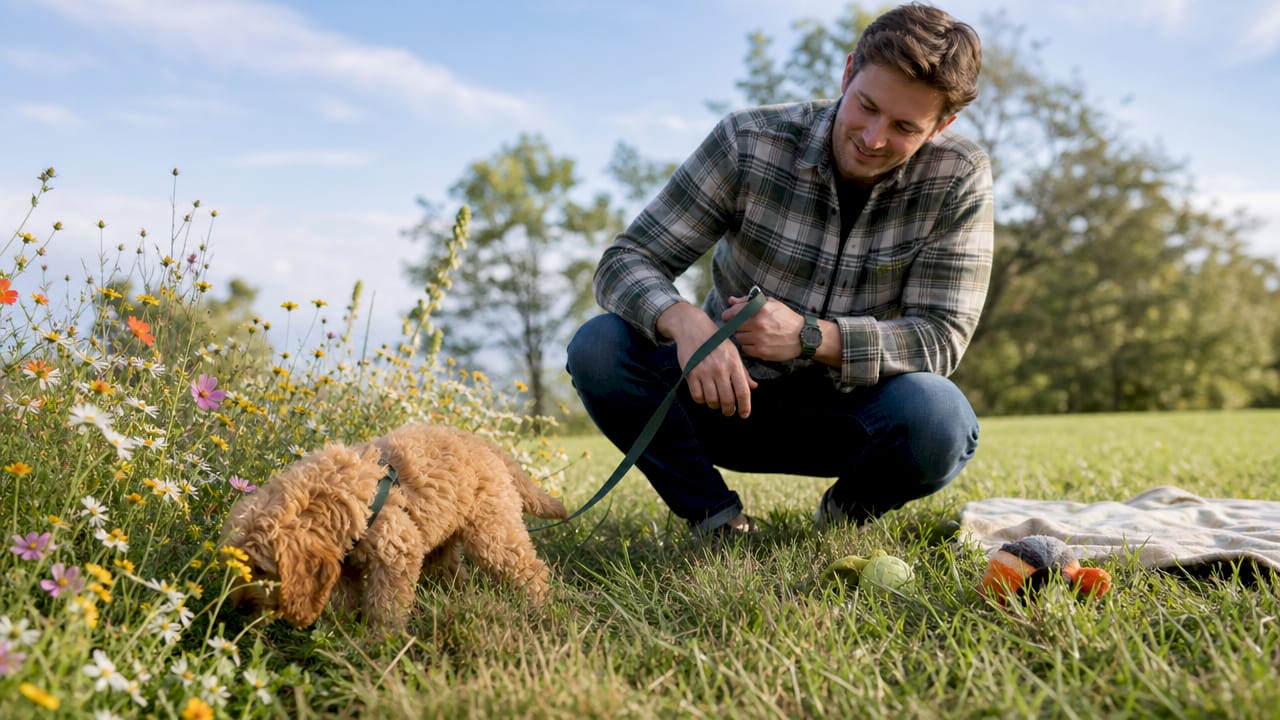
Breed size changes the timeline significantly. Small breeds like Cockapoos finish growing around 10–12 months. Medium breeds like Goldendoodles and Bernadoodles typically reach skeletal maturity between 12–15 months. Large and giant breeds can take up to 18 months or longer. The bigger the dog, the longer the growth plates stay vulnerable, so the five-minute rule matters even more for large breeds.
The type of exercise matters as much as the duration. Safe, low-impact options include:
- Short leash walks on grass or soft ground, not pavement
- Sniff walks where the puppy sets the pace and investigates freely
- Gentle fetch in a small yard with soft surfaces
- Brief training sessions of 3–5 minutes that combine movement with learning
- Supervised free play with appropriate-sized toys
High-impact activities like running on pavement, jumping on and off furniture, and sharp directional turns put serious stress on soft cartilage. These activities are the leading cause of early joint damage in young dogs. Stick to flat, soft surfaces until your vet confirms growth plate closure.
Pro Tip: If your puppy starts lagging behind on a walk or sits down without being asked, that is your cue to head home. Puppy behavior is a more reliable guide than the clock.
How to balance mental stimulation with physical activity
Mental exercise tires a puppy faster than physical exertion and carries zero joint risk. This is one of the most underused tools new owners have. A 10-minute nose game or food puzzle can leave a puppy more satisfied than a 30-minute walk. Mental stimulation through nose games and food puzzles tires puppies quickly without stressing their joints.
The best puppy exercise schedule combines both types of activity throughout the day. Physical sessions bookend the day, and mental enrichment fills the gaps. Here are the most effective mental and enrichment activities for puppies:
- Nose games: Hide a treat under one of three cups and let your puppy sniff it out. Start simple.
- Food puzzles: Kong-style toys stuffed with kibble or soft food work well for puppies 8 weeks and older.
- Short training sessions: Teaching “sit,” “down,” and “look at me” counts as both mental and physical activity.
- Sniff walks: Veterinary experts recommend investigative puppy walks over continuous leash walking. Let the puppy stop, sniff, and explore at will.
- Calm socialization: Sitting near a park and watching the world go by builds confidence without physical strain.
Socialization deserves its own note. True socialization means calm exposure to diverse environments, not constant high-energy play with other dogs. Overwhelming a puppy with too much dog-to-dog interaction too soon creates anxiety, not confidence. A quiet sit on a bench near a busy sidewalk teaches more than a chaotic puppy playgroup.
Rest is not optional. Puppies need frequent naps to reset their nervous systems, which are growing as fast as their bodies. A puppy that skips naps becomes overstimulated and harder to manage. Build rest periods into every part of the day.
Pro Tip: If your puppy seems wired and unable to settle, try a food puzzle before assuming they need more exercise. Overtired puppies often look hyperactive, not sleepy.
What are the signs of too much exercise in puppies?
Over-exercise is more common than most new owners realize. The signs are easy to miss because they do not always look like exhaustion. Signs of over-exercise include sudden reluctance to walk, flopping down mid-route, and erratic energy bursts known as “zoomies.” These behaviors signal that the puppy needs rest, not more activity.
Over-exercising young puppies can cause permanent joint damage. This is especially true for large and giant breeds whose growth plates stay open longest. The damage often does not show up until the dog is 2 or 3 years old, making prevention the only real strategy.
Common mistakes new owners make include:
- Taking puppies on long continuous walks because the puppy “seems fine”
- Allowing repeated jumping on and off sofas or beds
- Playing rough tug games that involve sharp pulling and twisting
- Letting older children run the puppy until it collapses
- Skipping rest periods because the puppy appears energetic
| Activity | Safe or Avoid? | Notes |
|---|---|---|
| Short leash walk on grass | Safe | Keep to five-minute rule per month of age |
| Running on pavement | Avoid | Hard surfaces stress developing joints |
| Gentle fetch on grass | Safe | Keep sessions under 10 minutes |
| Jumping on/off furniture | Avoid | Repeated impact damages growth plates |
| Sniff walk at puppy’s pace | Safe | Excellent for mental and physical balance |
| Rough tug with sharp turns | Avoid | Twisting motion risks soft cartilage |
| Training session (3–5 min) | Safe | Combines movement and mental stimulation |
| Forced jogging with owner | Avoid | Too high-impact for any puppy under 12 months |
A consistent daily routine with built-in rest periods is the single most effective way to prevent over-exercise. Puppies thrive on predictability. When they know a nap follows a walk, they settle faster and recover better.
Puppy exercise schedule examples by age and breed size
A practical schedule removes the guesswork. These examples follow the five-minute rule and two daily exercise sessions recommended by veterinary authorities. Adjust based on your puppy’s individual response, not just the clock.
| Age | Small Breed (e.g., Cockapoo) | Medium Breed (e.g., Goldendoodle) | Large Breed |
|---|---|---|---|
| 8–10 weeks | 2 x 10 min walk + 2 x 5 min play | 2 x 10 min walk + 2 x 5 min play | 2 x 10 min walk + rest focus |
| 3 months | 2 x 15 min walk + training | 2 x 15 min walk + training | 2 x 15 min walk + extra rest |
| 4 months | 2 x 20 min walk + puzzle toy | 2 x 20 min walk + puzzle toy | 2 x 20 min walk + calm play |
| 6 months | 2 x 30 min walk + fetch | 2 x 30 min walk + fetch | 2 x 30 min walk + sniff walk |
Each session should include a mix of structured movement and free sniffing. Training sessions of 3–5 minutes fit naturally between the walk and rest period. As your puppy matures and your vet confirms growth plate closure, you can gradually increase duration and introduce more varied activities.
Tracking your puppy’s response is simple. Watch for the behavioral cues described earlier. A well-exercised puppy eats, plays briefly, and then sleeps. A puppy that cannot settle after exercise likely got too much stimulation, not too little. You can find more detailed daily structure guidance in a day with a puppy from Lakewoodranchdoodles, which walks through realistic timing for meals, play, training, and rest.
For breed-specific puppy training guidance, Lakewoodranchdoodles also offers detailed resources built from over 20 years of hands-on experience with Goldendoodles, Bernadoodles, and Cockapoos.
Key Takeaways
Appropriate puppy exercise requires short, low-impact sessions guided by the five-minute rule, paired with mental enrichment and consistent rest to protect developing joints and support healthy growth.
| Point | Details |
|---|---|
| Follow the five-minute rule | Give 5 minutes of structured exercise per month of age, twice daily. |
| Protect growth plates | Avoid pavement, jumping, and sharp turns until your vet confirms skeletal maturity. |
| Prioritize mental enrichment | Nose games and food puzzles tire puppies effectively without joint stress. |
| Read behavioral cues | Flopping down or zoomies signal over-exercise; rest is the correct response. |
| Build a consistent routine | Two short daily sessions plus naps support security and balanced development. |
What 20 years of puppies taught me about exercise limits
New owners almost always make the same mistake. They see a puppy with energy and assume more exercise is the answer. The puppy bounces off the walls at 7:00 PM, so they take it for another walk. The walk makes things worse. The puppy comes home more wired, not calmer.
What I have learned from raising Goldendoodles, Bernadoodles, and Cockapoos over two decades is that the puppy’s body always tells the truth before the owner notices. A puppy that flops mid-walk is not being dramatic. It is telling you its nervous system hit its limit. The right move is to scoop it up and head home, not encourage it to keep going.
Mental enrichment changed how I think about puppy exercise entirely. A 5-minute training session teaching “sit” and “look at me” does more for a puppy’s development than a 20-minute forced walk. It builds focus, confidence, and the human-dog bond all at once. Physical exercise is one tool. It is not the whole toolkit.
My honest advice: trust the behavior, not the schedule. The five-minute rule is a ceiling, not a target. Some puppies need less. Some days call for more rest and less movement. Watch your puppy, not the clock. And when in doubt, call your vet. A 10-minute phone call with a professional beats a week of second-guessing.
— Lakewood
Puppies raised for exactly this kind of life
Lakewoodranchdoodles breeds Goldendoodles, Bernadoodles, and Cockapoos with service-animal-quality temperaments and exceptional trainability. Every puppy leaves with a foundation built for the kind of balanced, low-stress routine this article describes.
New owners get lifetime breeder support, including guidance on exercise, training, and development at every stage. If you are ready to meet a puppy raised for a healthy, well-rounded life, browse the current available puppies at Lakewoodranchdoodles. You can also book a visit in person at our Lindsay, Ontario location or connect virtually at 705 875 5195.
FAQ
What is the five-minute rule for puppy exercise?
The five-minute rule means 5 minutes of structured exercise per month of age, given twice daily. A 4-month-old puppy gets two 20-minute sessions per day.
Can I take my puppy for a walk before vaccinations are complete?
Short walks on private property or low-traffic areas are generally safe. Consult your vet about specific vaccination timelines before exposing your puppy to public spaces.
What are the best activities for puppies under 4 months?
Short leash walks on grass, gentle fetch, sniff walks, and 3–5 minute training sessions are the safest options. Avoid pavement, jumping, and rough play.
How do I know if my puppy is getting too much exercise?
Signs include sudden reluctance to walk, flopping down mid-session, and erratic zoomies after activity. These behaviors signal the puppy needs rest, not more movement.
Does mental stimulation count as exercise for puppies?
Yes. Nose games, food puzzles, and short training sessions tire puppies effectively and carry no joint risk, making them a critical part of any puppy exercise schedule.